


Page 7 - PEN eBook May 2023
P. 7
COVER STORY – DESIGN                                                                          COVER STORY – DESIGN

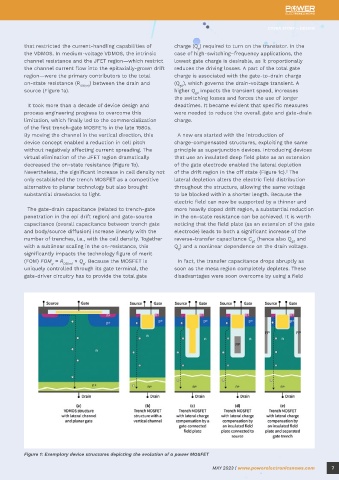
          that restricted the current-handling capabilities of   charge (Q ) required to turn on the transistor. In the
                                                                       g
          the VDMOS. In medium-voltage VDMOS, the intrinsic   case of high-switching–frequency applications, the
          channel resistance and the JFET region—which restrict   lowest gate charge is desirable, as it proportionally
          the channel current flow into the epitaxially-grown drift   reduces the driving losses. A part of the total gate
          region—were the primary contributors to the total   charge is associated with the gate-to-drain charge
          on-state resistance (R DS(on) ) between the drain and   (Q ), which governs the drain-voltage transient. A
                                                                gd
          source (Figure 1a).                                 higher Q  impacts the transient speed, increases
                                                                      gd
                                                              the switching losses and forces the use of longer
           It took more than a decade of device design and    deadtimes. It became evident that specific measures
          process engineering progress to overcome this       were needed to reduce the overall gate and gate-drain
          limitation, which finally led to the commercialization   charge.
          of the first trench-gate MOSFETs in the late 1980s.
          By moving the channel in the vertical direction, this   A new era started with the introduction of
          device concept enabled a reduction in cell pitch    charge-compensated structures, exploiting the same
          without negatively affecting current spreading. The   principle as superjunction devices. Introducing devices
          virtual elimination of the JFET region dramatically   that use an insulated deep field plate as an extension
          decreased the on-state resistance (Figure 1b).      of the gate electrode enabled the lateral depletion
          Nevertheless, the significant increase in cell density not   of the drift region in the off state (Figure 1c).  The
                                                                                                     2
          only established the trench MOSFET as a competitive   lateral depletion alters the electric field distribution
          alternative to planar technology but also brought   throughout the structure, allowing the same voltage
          substantial drawbacks to light.                     to be blocked within a shorter length. Because the
                                                              electric field can now be supported by a thinner and
 Accelerating the Drive   penetration in the epi drift region) and gate-source   more heavily doped drift region, a substantial reduction
           The gate-drain capacitance (related to trench-gate
                                                              in the on-state resistance can be achieved. It is worth
 for Higher Efficiencies   capacitance (overall capacitance between trench gate   noticing that the field plate (as an extension of the gate
                                                              electrode) leads to both a significant increase of the
          and body/source diffusion) increase linearly with the
                                                              reverse-transfer capacitance C  (hence also Q  and
          number of trenches, i.e., with the cell density. Together
                                                                                                       gd
                                                                                         gd
                                                              Q ) and a nonlinear dependence on the drain voltage.
          with a sublinear scaling in the on-resistance, this
 Through Power MOSFET   significantly impacts the technology figure of merit   soon as the mesa region completely depletes. These
                                                                g
          (FOM) FOM  = R
                                                               In fact, the transfer capacitance drops abruptly as
                            × Q . Because the MOSFET is
                   g
                       DS(on)
                              g
          uniquely controlled through its gate terminal, the
 Technology Innovation  gate-driver circuitry has to provide the total gate   disadvantages were soon overcome by using a field
 Introducing Infineon’s latest OptiMOS™ 6 device
 technology—a novel cell-design approach for higher

 power densities and cost-effectiveness


 By Ralf Siemieniec, Senior Principal Engineer Power Device Development; Simone
 Mazzer, Senior Engineer Product Applications; Cesar Braz, Principal Engineer Product
 Definition; Michael Hutzler, Lead Principal Engineer Technology Development; David
 Laforet, Lead Principal Engineer Technology Development; Ingmar Neumann, Principal
 Engineer Technology Development; Elias Pree, Senior Staff Engineer Technology
 Development; and Alessandro Ferrara, Principal Engineer Product Concept, all at
 Infineon Technologies


 MOSFET technology has been widely recognized as   switch. Due to its superior switching performance and
 1
 an excellent option for switches in power management   high input impedance, the MOSFET quickly emerged
 circuits since its inception. Commercially available   as an attractive alternative to bipolar technologies.
 since the late 1970s, vertical diffused MOSFET (VDMOS)   However, its application in the power electronics
 structures were the first to fulfill the need for a power   industry was limited by the high on-state resistance   Figure 1: Exemplary device structures depicting the evolution of a power MOSFET

 6  MAY 2023 | www.powerelectronicsnews.com                                 MAY 2023 | www.powerelectronicsnews.com  7

