


Page 15 - PEN eBook July 2022
P. 15
Thermal Management                                                                  Thermal Management


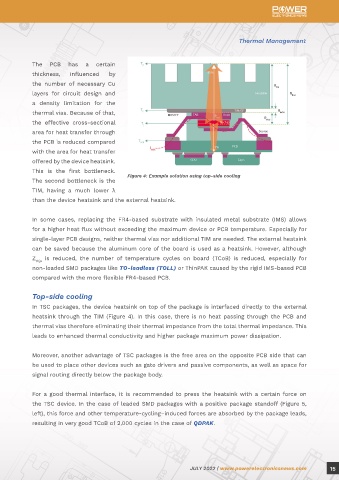
            The  PCB  has  a  certain
            thickness,    influenced   by
            the number of necessary Cu

            layers  for circuit design and
            a  density  limitation  for  the
            thermal vias. Because of that,
            the  effective  cross-sectional
            area for heat transfer through
            the PCB is reduced compared
            with the area for heat transfer
            offered by the device heatsink.
            This  is  the  first  bottleneck.
 Figure 2: Optimization results of the entire server power supply showing efficiency versus density, with the optimal LLC   Figure 4: Example solution using top-side cooling
 stage frequency  The second bottleneck is the
            TIM,  having  a  much  lower  λ
 SMD PACKAGES USED IN SMPS TOPOLOGIES  than the device heatsink and the external heatsink.

 Infineon offers a larger portfolio of bottom-side cooling (BSC) and top-side cooling (TSC) packages
 that  fulfill  the  higher-power  and  higher-density  trends  in  server  switch-mode  power  supply   In  some  cases,  replacing the  FR4-based  substrate with  insulated  metal  substrate  (IMS)  allows
 (SMPS)  applications.  This  section  discusses  and  compares  the  different  packages  concerning   for a higher heat flux without exceeding the maximum device or PCB temperature. Especially for
 topics such as assembly, thermal performance, and electrical parasitics.  single-layer PCB designs, neither thermal vias nor additional TIM are needed. The external heatsink

            can be saved because the aluminum core of the board is used as a heatsink. However, although
 ASSEMBLY IMPLEMENTATIONS OF BSC AND TSC PACKAGES   Z thja  is reduced,  the number of  temperature cycles on board (TCoB) is reduced, especially  for
 Bottom-side cooling  non-leaded SMD packages like TO-leadless (TOLL) or ThinPAK caused by the rigid IMS-based PCB

 Figures 3 and 4 show the principal cooling concept for BSC and TSC. In both cases, the SMD package is   compared with the more flexible FR4-based PCB.
 mounted on the PCB, usually via a reflow-soldering process. For BSC, the main heat flux is directed from
 the device heatsink (exposed pad) on the bottom of the package through the PCB to an external heatsink   Top-side cooling
 mounted on the opposite side of the PCB. Therefore, thermal vias below the package and through the   In TSC packages, the device heatsink on top of the package is interfaced directly to the external
 PCB are needed for heat transfer when using an FR4-based PCB. On the backside of the PCB, the   heatsink through the TIM (Figure 4). In this case, there is no heat passing through the PCB and
 external heatsink is mounted   thermal vias therefore eliminating their thermal impedance from the total thermal impedance. This

 on the  area  with the thermal   leads to enhanced thermal conductivity and higher package maximum power dissipation.
 vias. The heatsink and the PCB
 are  electrically  separated  via   Moreover, another advantage of TSC packages is the free area on the opposite PCB side that can
 a  thermal interface material   be used to place other devices such as gate drivers and passive components, as well as space for
 (TIM).  Quite  often,  a  foil  with   signal routing directly below the package body.
 a  thickness in  the range of
 100–500  μm  is  used  as  TIM,   For a good thermal interface, it is recommended to press the heatsink with a certain force on

 which has,  in  the best case,   the TSC device. In the case of leaded SMD packages with a positive package standoff (Figure 5,
 a good  thermal admittance   left), this force and other temperature-cycling–induced forces are absorbed by the package leads,
 (λ). This leads ideally to a low   resulting in very good TCoB of 2,000 cycles in the case of QDPAK.
 thermal  impedance  (Z ) for
 thja
 the overall system.
 Figure 3: Example solution using bottom-side cooling


 14  JULY 2022 | www.powerelectronicsnews.com                       JULY 2022 | www.powerelectronicsnews.com         15

