


Page 13 - PEN eBook July 2022
P. 13
THERMAL MANAGEMENT                                                                  Thermal Management


            To  achieve  the  required  higher  power  density,  the  following  three  main  contributors  must  be
            considered:


             ▶   Increased efficiency to maintain an acceptable total power loss in a given volume. This
                drives the transition to new topologies and technologies. A great example is the transition
                from the conventional silicon classic-boost PFC to the gallium nitride/silicon carbide
                totem-pole PFC.


             ▶   Improved packages and thermal solutions that can dissipate the power away from
                the device junction to
                heatsinks and ambient.
                This becomes more

                challenging in smaller
                surface-mount device
                (SMD) packages that are
                the main enabler for
                high-density converters.
 Packaging and   ▶   Optimized     system     Figure 1: Server supply comprising a totem-pole PFC and an LLC DC/DC

                                              converter
 Thermal Solutions to   design  and  switching

                frequency  to  achieve  maximum  density  without  violating  efficiency  requirements  or
 Fulfill Trends in Data   temperature-rise  limits.  This  leads  to  an  increased  switching  frequency,  driving  the
                transition from conventional to new packages and thermal solutions.

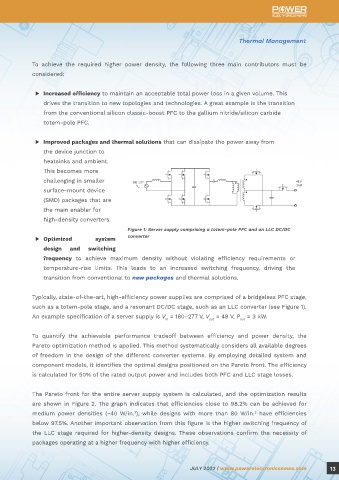
 Centers and Server SMPS  Typically, state-of-the-art, high-efficiency power supplies are comprised of a bridgeless PFC stage,

            such as a totem-pole stage, and a resonant DC/DC stage, such as an LLC converter (see Figure 1).
            An example specification of a server supply is V  = 180–277 V, V  = 48 V, P  = 3 kW.
                                                                                     out
                                                                          out
                                                           in
 How to meet the design requirements
 of power supplies using silicon and   To  quantify  the  achievable  performance  tradeoff  between  efficiency  and  power  density,  the
            Pareto optimization method is applied. This method systematically considers all available degrees
 wide-bandgap switches  of freedom in the design of the different converter systems. By employing detailed system and
            component models, it identifies the optimal designs positioned on the Pareto front. The efficiency

 By Daniel Hölzl, package concept engineer, and Sam Abdel-Rahman, system   is calculated for 50% of the rated output power and includes both PFC and LLC stage losses.
 architect for server/data center SMPS, both at Infineon Technologies
            The Pareto front for the entire server supply system is calculated, and the optimization results

            are shown in Figure 2. The graph indicates that efficiencies close to 98.2% can be achieved for
 The  emergence  of  cloud-based  internet  services,  artificial  intelligence,  and  cryptocurrency  has   medium power densities (~40 W/in. ), while designs with more than 80 W/in.  have efficiencies
                                                                                          3
                                                3
 initiated a strong growth of processing power in data centers worldwide. In combination with rising   below 97.5%. Another important observation from this figure is the higher switching frequency of
 electricity and real estate prices, this trend creates a clear need for highly efficient and compact   the LLC stage required for higher-density designs. These observations confirm the necessity of
 server power supplies.  packages operating at a higher frequency with higher efficiency.


 12  JULY 2022 | www.powerelectronicsnews.com                       JULY 2022 | www.powerelectronicsnews.com         13

