


Page 17 - PEN eBook December 2022
P. 17
SEMICONDUCTORS                                                                            Semiconductors


            The  cascode  configuration
            makes the part convenient to
            use  with  easy  gate  drive  but

            diminishes controllability. The
            cascode  switching  speed  is
            largely  defined  by  the  JFET
            gate-drain capacitance and
            the internal series resistor
            R   from  JFET  gate  to  the
              G
            Si-MOSFET  source.  R  is
                                     G
            a  predefined  value  and  is
            inaccessible.  The Si-MOSFET

            gate  has  limited  effect  on
            speed    because    there   is
            virtually no JFET drain-source
            capacitance    which    would
            otherwise feed current back to
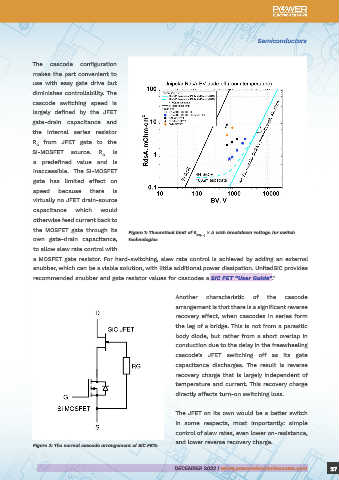
 Approaching the   the  MOSFET  gate through  its   Figure 1: Theoretical limit of R DS(on)  × A with breakdown voltage for switch

            own gate-drain capacitance,
                                              technologies
 Perfect Switch with   to allow slew rate control with
            a MOSFET gate resistor. For hard-switching, slew rate control is achieved by adding an external
            snubber, which can be a viable solution, with little additional power dissipation. UnitedSiC provides
 SiC JFETs  recommended snubber and gate resistor values for cascodes a SiC FET “User Guide”.    2


                                                              Another    characteristic   of   the   cascode
 By Jonathan Dodge, senior applications engineer at UnitedSiC/Qorvo
                                                              arrangement is that there is a significant reverse
                                                              recovery effect, when cascodes in series form
 SiC JFETs are robust, with high-energy avalanche and short-circuit withstand ratings, and significantly,   the leg of a bridge. This is not from a parasitic

 they beat all other technologies for the FOM on-resistance per unit die area R   × A, achieving a   body diode, but rather from a short overlap in
 DS(on)
 value close to the theoretical limit for the material (Figure 1). This figure of merit directly relates to   conduction due to the delay in the freewheeling
 the practical performance of the switch and its economy, with more die per wafer for comparable   cascode’s  JFET  switching  off  as  its  gate
 performance than competing technologies.                     capacitance discharges.  The result is reverse
                                                              recovery charge that is largely independent of
 CAN WE DO BETTER STILL?                                      temperature and current. This recovery charge
 SiC cascodes from UnitedSiC (now Qorvo)  have a significant edge in many applications, but can they   directly affects turn-on switching loss.
 1
 be better? The device comprises a SiC JFET and Si-MOSFET in a cascode arrangement to achieve
 a  normally-off  characteristic.  Looking  at  the  detail,  a  cascode  is  formed  as  in  Figure  2  with  the   The JFET on its own would be a better switch
 Si-MOSFET switching the source of the SiC JFET so that when the Si-MOSFET is off, the JFET source   in some respects, most importantly: simple
 floats positive, turning the JFET off. When the MOSFET is on, the JFET gate and source are effectively   control of slew rates, even lower on-resistance,
 shorted, turning it on.                                      and lower reverse recovery charge.
            Figure 2: The normal cascode arrangement of SiC FETs


 26  DECEMBER 2022 | www.powerelectronicsnews.com             DECEMBER 2022 | www.powerelectronicsnews.com           27

