


Page 15 - PEN eBook December 2022
P. 15
POWER SUPPLIES                                                                             Power Supplies


            Reduced volume not only enhances the user experience, but it also lowers manufacturing and delivery
            expenses. To achieve higher power densities, a common practice is to increase the switching frequency,
                                                                                                            3
            which also helps to reduce the size of both inductors and capacitors.  Operating at a higher frequency,
                                                                             4,5
            however, affects the overall efficiency and thermal management. As a result, power inductors should
            be able to work under a large current with minimal power loss.


            On the market, there are two main types of power inductors: ferrite and metal composite. Due
            to its high permeability, wire-wound ferrite is an ideal choice for high-inductance applications.
            However, its small saturation flux density limits the size reduction of power inductors and involves
            thermal management issues. On the other hand, a higher saturation flux density is provided by
            a metal-composite–type inductor, usually built with alloy powder and organic binders with coil
            molded inside. At a higher temperature, however, performance deteriorates due to the presence of

            organic resin, while power losses are higher than in a ferrite inductor.

            THE NOVEL INDUCTOR DESIGN
 A Novel Inductor Design   The new inductor employs as magnetic material an Fe-based alloy powder named NPA-F, characterized

            by low loss and high saturation. The material is manufactured in a spherical shape using the gas
 Boosts Efficiency in   atomization method. That ensures low eddy current loss even at high frequency and protects against
            insulation layer cracking.

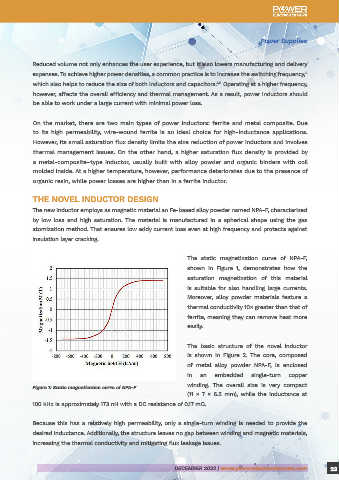
 DC/DC Converters                                                  The  static  magnetization  curve  of  NPA-F,


                                                                   shown  in  Figure  1,  demonstrates  how  the
                                                                   saturation magnetization of  this material
 By Stefano Lovati, technical writer for EEWeb
                                                                   is suitable for also handling large currents.
                                                                   Moreover, alloy powder materials  feature a
 The inductor is a key component in DC/DC converters due to its ability to suppress the AC ripple   thermal conductivity 10× greater than that of
 current, providing in output a smoothed DC current.  The latest-generation electronic devices are   ferrite, meaning they can remove heat more
 extremely compact and with increasingly advanced features. Usually battery-powered, they require high   easily.

 energy efficiency, starting with basic components like inductors found in DC/DC converters. Because
 the efficiency of an inductor is strictly dependent on the core and winding losses, it shall absorb ripple   The basic structure of  the novel inductor
 current while minimizing losses.                                  is  shown  in  Figure  2.  The  core,  composed
                                                                   of  metal  alloy  powder  NPA-F,  is  enclosed
 This article  will present a novel power inductor design  to be used in compact and large current   in  an  embedded  single-turn  copper
 DC/DC  converters,  suitable  to  operate  even  at  high  frequencies.  This  inductor,  based  on  an  iron   winding.  The overall size is  very compact
            Figure 1: Static magnetization curve of NPA-F
 (Fe)-based alloy powder, exhibits excellent performance with increased efficiency and smaller size   (11 × 7 × 6.5 mm), while the inductance at

 compared with a conventional ferrite inductor. Read the original article here. 6  100 kHz is approximately 173 nH with a DC resistance of 0.17 mΩ.

 PERFORMANCE VS. SIZE  Because this has a relatively high permeability, only a single-turn winding is needed to provide the

 Today,  engineers  are  demanded  to  design  smaller  power  supplies  with  improved  efficiency  for   desired inductance. Additionally, the structure leaves no gap between winding and magnetic materials,
 powering ICs like FPGAs and GPUs, which notoriously operate at a lower voltage and larger current.    increasing the thermal conductivity and mitigating flux leakage issues.
 1,2


 22  DECEMBER 2022 | www.powerelectronicsnews.com             DECEMBER 2022 | www.powerelectronicsnews.com           23

