


Page 47 - EE Times Europe Magazine - June 2025
P. 47
EE|Times EUROPE   47


         AUTONOMOUS DRIVING | IN-CABIN MONITORING SYSTEMS
        Face Value: AI That Knows When You’re


        Too Tired to Drive


        By Rebecca Pool
        As vehicles edge closer to full autonomy, in-cabin monitoring is swerving from gaze

        tracking to full emotion insight.


               t U.K.-based Blueskeye AI,
               a team of facial expression
               analysts spends a lot of
        A their time reviewing images
        of faces, tagging tiny nuances in
        muscle movement with meticulous
        precision. It could be a curl of the lip
        or a slightly raised eyebrow; either
        way, the high-quality, annotated data
        will be used to train facial recognition
        and emotion AI models.
          The Facial Action Coding System
        (FACS) annotator—also known as
        muscle action coder—isn’t a new
        concept. Developed by psychologists
        back in the 1970s, FACS is now a glob-
        ally recognized tool to measure visual
        facial changes caused by muscle
        actions and thereby analyze the full
        range of human expression. What is
        new is the application of FACS anno-
        tation in software development for
        in-car monitoring systems designed
        to monitor driver behavior and detect
        signs of distraction, fatigue, and
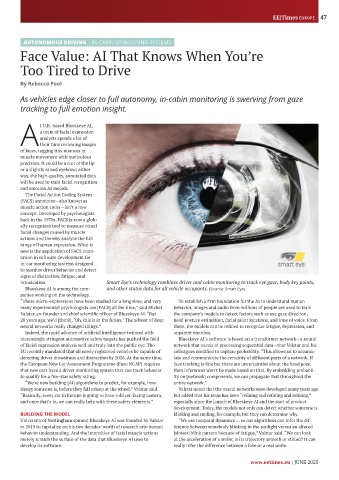
        intoxication.                 Smart Eye’s technology combines driver and cabin monitoring to track eye gaze, body key points,
          Blueskeye AI is among the com-  and other status data for all vehicle occupants. (Source: Smart Eye)
        panies working on the technology.
        “These micro-expressions have been studied for a long time, and very   To establish a firm foundation for the AI to understand human
        many experimental psychologists use [FACS] all the time,” said Michel   behavior, images and audio from millions of people are used to train
        Valstar, co-founder and chief scientific officer of Blueskeye AI. “But    the company’s models to detect factors such as eye gaze direction,
        20 years ago, we’d [think], ‘Oh, this is in the future.’ The advent of deep   head posture estimation, facial point locations, and tone of voice. From
        neural networks really changed things.”               there, the models can be refined to recognize fatigue, depression, and
          Indeed, the rapid advance of artificial intelligence twinned with   apparent emotion.
        increasingly stringent automotive safety targets has pushed the field   Blueskeye AI’s software is based on a transformer network—a neural
        of facial expression analysis well and truly into the public eye. The   network that excels at processing sequential data—that Valstar and his
        EU recently mandated that all newly registered vehicles be capable of   colleagues modified to capture probability. “This allows us to accumu-
        detecting driver drowsiness and distraction by 2026. At the same time,   late and communicate the certainty of different parts of a network. If
        the European New Car Assessment Programme (Euro NCAP) requires   face tracking is fine but there are uncertainties about the head pose,
        that new cars have a driver monitoring system that can track behavior   then inferences won’t be made based on that. By embedding probabil-
        to qualify for a five-star safety rating.             ity on [network] components, we can propagate that throughout the
          “We’re now building [AI] algorithms to predict, for example, how   entire network.”
        sleepy someone is, before they fall asleep at the wheel,” Valstar said.   Valstar noted that the neural networks were developed many years ago
        “Basically, every car in Europe is going to have a driver-facing camera,   but added that his team has been “refining and refining and refining,”
        and once that’s in, we can really help with these safety elements.”  especially since the launch of Blueskeye AI and the start of product
                                                              development. Today, the models not only can detect whether someone is
        BUILDING THE MODEL                                    blinking and smiling, for example, but they can determine why.
        University of Nottingham spinout Blueskeye AI was founded by Valstar   “We use temporal dynamics … so our algorithms can infer the dif-
        in 2019 to capitalize on his two decades’ worth of research into human   ference between somebody blinking in the sunlight versus an altered
        behavior understanding. And the intensities of facial muscle actions   [slower] blink pattern because of fatigue,” Valstar said. “We can look
        merely scratch the surface of the data that Blueskeye AI uses to   at the acceleration of a smile; is its trajectory smooth or stilted? It can
        develop its software.                                 really infer the difference between a fake or a real smile.


                                                                                         www.eetimes.eu | JUNE 2025

