


Page 49 - EE Times Europe Magazine - June 2025
P. 49
EE|Times EUROPE   49


         AUTONOMOUS DRIVING | IN-CABIN MONITORING SYSTEMS
        Time-of-Flight and Radar Take the Wheel


        By Rebecca Pool

        Can a new generation of in-cabin sensors deliver the safety essential for tomorrow’s
        autonomous cars?


                  s cars steer ever closer to autonomous driving, driver monitoring   than 25 million systems are being used in
                  and in-cabin monitoring systems are set to play a truly critical role   augmented-reality systems, smartphones,
                                                                                driver monitoring and in-cabin sensing sys-
                  in passenger safety. 3D time-of-flight (ToF) imagers and 60-GHz   tems, and more.
        A radar are two sensors that could make a big difference, given their     To gather data, these devices illuminate the
        abilities to detect occupants and monitor behavior—and the two technologies   area of interest with modulated infrared light,
                                                                                which reflects and is then detected by an
        are already being integrated into such monitoring platforms.            imager and compared with the emitted light.
                                                                                Distance information in each pixel, obtained
          Driver monitoring systems (DMS) have been around for more than   from the detected phase shifts, is combined with a 2D grayscale image
        a decade, typically relying on infrared cameras to assess attentiveness   to generate 3D information of the scene. And in a car, such 3D data is
        by directly observing a driver’s facial orientation, glance behavior,   critical.
        and eye movements in real time. Today, global safety regulations are   Smart airbags, for example, use sensors to detect driver or occupant
        driving the integration of more advanced driver distraction warn-  size as well as motion so that the best timing and deployment force
        ing (ADDW) systems and wider in-cabin monitoring systems into   can be determined. “In this scenario, we really need body tracking,
        vehicles.                                             estimates of the size and weight of passengers, even how they are
          The EU has mandated that all newly registered vehicles be capable   seated in front of the airbag,” Lass said. “We can get some of this
        of detecting driver drowsiness and distraction by 2026. In parallel,   information from 2D cameras, but we really need depth information,
        the European New Car Assessment Programme (Euro NCAP) requires   and this is a key example of where 3D and time-of-flight cameras can
        new cars to have a DMS—with a raft of features beyond driver   come into play.”
        impairment—to achieve a five-star safety rating. Think child presence   Unlike conventional cameras, Lass added, 3D ToF sensors can
        detection, information on numbers of occupants in a vehicle, posture   provide robust data under all ambient light, as they are not affected by
        monitoring to enhance seat belt use, airbag parameters for smart   shadows and sunlight overexposure. But the technology has its limits.
        airbags, and more.                                      For example, ToF imagers cannot directly measure vital signs, a
          “The industry, driven by Euro NCAP, has really been heading toward   critical aspect of driver impairment monitoring. The sensors will
        direct driver monitoring, which is now leading us to these advanced   also struggle to provide the higher resolution demanded by the
        driver distraction warning systems,” said Martin Lass, head of ToF   wide-view cameras that will be used to monitor all occupants in a
        business at Infineon Technologies. “These systems will really detect   car. But an alternative sensor, the 60-GHz radar, could help.
        if, say, a driver has his or her eyes on
        the road, their hands on the steering
        wheel, or if something is being handed
        over from the back of the car to the
        driver.”

        HIDDEN DEPTHS
        The complex use cases associated with
        ADDW systems will demand more than
        the 2D cameras and infrared sensors
        used in earlier driver monitoring sys-
        tems. 3D ToF sensors are one option
        currently under consideration. The
        sensors can accurately detect objects
        and track movement, making them
        suitable for mapping occupants and
        monitoring gestures in a car.
          The technology is hardly new,
        having been manufactured by the
        likes of Texas Instruments,
        STMicroelectronics, Melexis, and
        Infineon for several years. Infineon
        partnered with 3D ToF hardware and
        software pioneer pmdtechnologies
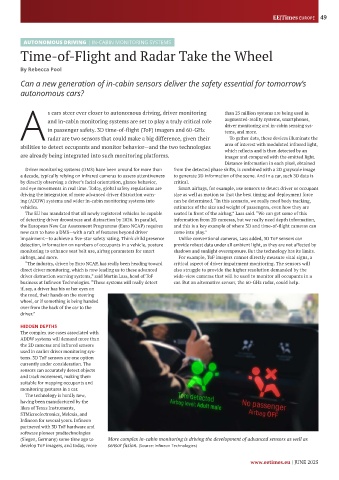
        (Siegen, Germany) some time ago to   More complex in-cabin monitoring is driving the development of advanced sensors as well as
        develop ToF imagers, and today, more   sensor fusion. (Source: Infineon Technologies)


                                                                                         www.eetimes.eu | JUNE 2025

