


Page 7 - EE Times Europe Magazine - June 2025
P. 7
EE|Times EUROPE   7

                              How Egypt, Saudi Arabia, and Oman Are Building the Middle East’s Chip Future


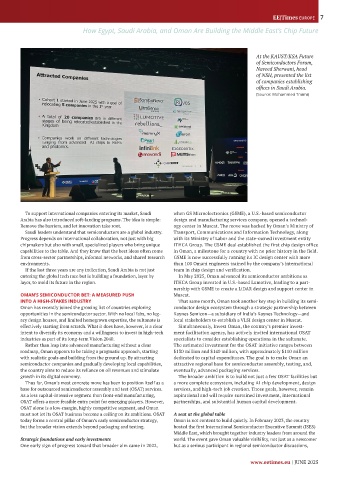
                                                                                           At the KAUST/KSA Future
                                                                                           of Semiconductors Forum,
                                                                                           Naveed Sherwani, head
                                                                                           of NSH, presented the list
                                                                                           of companies establishing
                                                                                           offices in Saudi Arabia.
                                                                                           (Source: Mohammed Tmimi)


          To support international companies entering its market, Saudi   when GS Microelectronics (GSME), a U.S.-based semiconductor
        Arabia has also introduced soft-landing programs. The idea is simple:   design and manufacturing services company, opened a technol-
        Remove the barriers, and let innovation take root.    ogy center in Muscat. The move was backed by Oman’s Ministry of
          Saudi leaders understand that semiconductors are a global industry.   Transport, Communications and Information Technology, along
        Progress depends on international collaboration, not just with big   with its Ministry of Labor and the state-owned investment entity
        chipmakers but also with small, specialized players who bring unique   ITHCA Group. The GSME deal established the first chip design office
        capabilities to the table. And they know that the best ideas often come   in Oman, a milestone for a country with no prior history in the field.
        from cross-sector partnerships, informal networks, and shared research   GSME is now successfully running its IC design center with more
        environments.                                         than 100 Omani engineers trained by the company’s international
          If the last three years are any indication, Saudi Arabia is not just   team in chip design and verification.
        entering the global tech race but is building a foundation, layer by   In May 2025, Oman advanced its semiconductor ambitions as
        layer, to mold its future in the region.              ITHCA Group invested in U.S.-based Lumotive, leading to a part-
                                                              nership with GSME to create a LiDAR design and support center in
        OMAN’S SEMICONDUCTOR BET: A MEASURED PUSH             Muscat.
        INTO A HIGH-STAKES INDUSTRY                             That same month, Oman took another key step in building its semi-
        Oman has recently joined the growing list of countries exploring   conductor design ecosystem through a strategic partnership between
        opportunities in the semiconductor sector. With no local fabs, no leg-  Kaynes Semicon—a subsidiary of India’s Kaynes Technology—and
        acy design houses, and limited homegrown expertise, the sultanate is   local stakeholders to establish a VLSI design center in Muscat.
        effectively starting from scratch. What it does have, however, is a clear   Simultaneously, Invest Oman, the country’s premier invest-
        intent to diversify its economy and a willingness to invest in high-tech   ment facilitation agency, has actively invited international OSAT
        industries as part of its long-term Vision 2040.      specialists to consider establishing operations in the sultanate.
          Rather than leap into advanced manufacturing without a clear   The estimated investment for the OSAT initiative ranges between
        roadmap, Oman appears to be taking a pragmatic approach, starting   $130 million and $140 million, with approximately $110 million
        with realistic goals and building from the ground up. By attracting   dedicated to capital expenditures. The goal is to make Oman an
        semiconductor companies and gradually developing local capabilities,   attractive regional base for semiconductor assembly, testing, and,
        the country aims to reduce its reliance on oil revenues and stimulate   eventually, advanced packaging services.
        growth in its digital economy.                          The broader ambition is to build not just a few OSAT facilities but
          Thus far, Oman’s most concrete move has been to position itself as a   a more complete ecosystem, including AI chip development, design
        base for outsourced semiconductor assembly and test (OSAT) services.   services, and high-tech job creation. Those goals, however, remain
        As a less capital-intensive segment than front-end manufacturing,   aspirational and will require sustained investment, international
        OSAT offers a more feasible entry point for emerging players. However,   partnerships, and substantial human capital development.
        OSAT alone is a low-margin, highly competitive segment, and Oman
        must not let its OSAT business become a ceiling on its ambitions. OSAT   A seat at the global table
        today forms a central pillar of Oman’s early semiconductor strategy,   Oman is not content to build quietly. In February 2023, the country
        but the broader vision extends beyond packaging and testing.  hosted the first International Semiconductor Executive Summit (ISES)
                                                              Middle East, which brought together industry leaders from around the
        Strategic foundations and early investments           world. The event gave Oman valuable visibility, not just as a newcomer
        One early sign of progress toward that broader aim came in 2022,   but as a serious participant in regional semiconductor discussions,


                                                                                         www.eetimes.eu | JUNE 2025

