


Page 54 - 23_EETE_03
P. 54
54 EE|Times EUROPE


         COMMUNICATIONS
        How Modular SDRs Help Achieve Environmental


        Sustainability


        By Kaue Morcelles, Per Vices

              he advancement of RF technology in various industries, including radar, electronic war-  highest-performance SDRs can receive 3 GHz
              fare (EW) and signal intelligence (SIGINT), has led to the development of complex radio   of instantaneous bandwidth using multiple
              systems that are often expensive and not environmentally sustainable. These systems   independent channels and DACs/ADCs. The
        T require a large number of discrete components, increasing not only their size and cost   digital back end, which is typically imple-
        but also the amount of electronic waste. However, with the advent of modular software-defined   mented using a field-programmable gate
        radio (SDR), systems integrators can now take advantage of fully integrated systems that can   array (FPGA), contains on-board
        help reduce the total number of components and size of the systems being deployed while being   digital-signal–processing (DSP) capabilities
        more environmentally friendly.                                          for modulation, demodulation, upconverting,
                                                                                down-converting and data packetization over
          Modular SDRs can be integrated into large   reduce the overall size and footprint of the   Ethernet optical links. The data is typically in
        production systems across many industries to   whole system and make it more convenient to   the form of VITA49 IQ data in the Ethernet
        reduce the overall number of components and   deploy and operate.       stack, which enables easy integration with
        the size of the systems being deployed. Their   In this article, we will discuss the impact of   open-source RF software, host networks,
        modularity allows for specific boards or elec-  modular SDRs on system integration and how   workstations and storage solutions. The
        tromechanical components to be replaced,   they can be leveraged to achieve sustainable   highest-bandwidth SDRs have a backhaul/data
        thereby reducing the overall waste that   solutions.                    throughput of 4 × 100 Gbps over quad small-
        comes from system updates and upgrades.                                 form–factor pluggable (qSFP+) transceivers
        Additionally, they can help extend the life of   WHAT IS AN SDR?        for interfacing to external equipment.
        already in-field hardware through their use in   An SDR is a type of radio communication sys-
        service-life–extension programs (SLEPs).  tem in which the functionality is defined by   HOW SDRs ARE USED IN RADAR, SIGINT
          SDRs can also be easily reconfigured on the   software rather than by hardware. Their high   AND EW
        fly to adapt to changing requirements and   flexibility and reconfigurability allow them to   SDRs are widely used in industries like radar,
        environments, resulting in lower costs and   be used in a wide range of applications and   SIGINT and EW, as they offer a highly flexible
        less downtime. Unlike traditional systems,   frequencies.               and reconfigurable solution with minimal
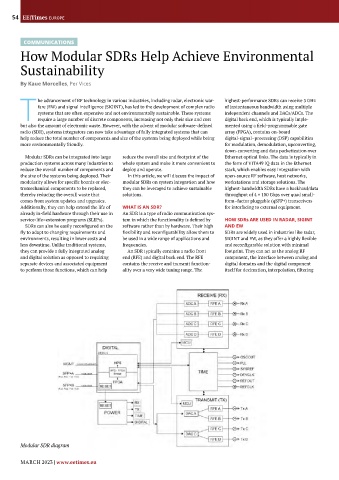
        they can provide a fully integrated analog   An SDR typically contains a radio front   footprint. They can act as the analog RF
        and digital solution as opposed to requiring   end (RFE) and digital back end. The RFE   component, the interface between analog and
        separate devices and associated equipment   contains the receive and transmit function-  digital domains and the digital component
        to perform those functions, which can help   ality over a very wide tuning range. The   itself for decimation, interpolation, filtering


        Modular SDR diagram

        MARCH 2023 | www.eetimes.eu

