


Page 58 - 23_EETE_03
P. 58
58 EE|Times EUROPE


         3D VISUALIZATION
        Farewell to the ‘Paralyzed Cyclops’


        By Christine Evans-Pughe

        Could the principles of medieval art radically improve how we interact with computer-
        generated images? The founders of U.K. technology startup Fovotec think so, and big
        players in 3D graphics are taking notice.


              ix hundred years ago, Italian Renaissance artists Filippo   Europe. “This is the difference between what humans and cameras see.”
              Brunelleschi and Leon Battista Alberti tore up the art rule book   Pepperell and Burleigh have spent the past 10 years reverse-
              with a revolutionary approach to depicting 3D objects. Called   engineering art to better understand how human eyes and brains
        Slinear perspective, it was so successful that even today, it’s how                interpret images and objects.
        computers display 3D scenes and images.               FovoRender alters            Through their startup,
          Linear perspective geometrically sizes objects relative to each other            Fovotec, they’ve turned these
        according to their distance from an imagined observer. It’s based on   images on screens to   findings into patented algo-
        the physics of light through a pinhole. As objects in a scene recede in            rithms, called FovoRender,
        depth, they shrink in size, just as we see in photographs.  replicate human visual   that alter the images we see
          But despite wide cultural acceptance, linear perspective is like having   perception, which could   on screens to replicate human
        blinkers on. Artist David Hockney has called it “the point of view of a            visual perception. They think
        paralyzed cyclops.”                                   change the way we            their approach could revolu-
          Our natural binocular vision extends 180˚ horizontally. Linear per-              tionize the way we interact
        spective images only look natural to us in the middle 50˚, as if looking   interact with screens,   with screens, social media,
        through a window. As the field of view widens, the depth shrinkage of   social media, and more.  architectural design, games
        objects drawn in this way becomes more extreme, and objects at the                 and more.
        margins of the image appear stretched.                                               FovoRender is based on
          Even in that middle 50˚ sweet spot, linear perspective doesn’t match   optical principles used in medieval religious paintings. As Pepperell
        with how we really see the world, according to Robert Pepperell and   and Burleigh have shown in a recent academic paper  with psycholo-
                                                                                                   1
        Alistair Burleigh from the Cardiff School of Art and Design at Cardiff   gist Nicole Ruta, medieval artists directed attention toward the most
        Metropolitan University. “Many people have tried to photograph a   prominent people in a scene by enlarging them. In this way, they found
        huge full moon and been disappointed by the little fuzzy disc they see   they could emotionally engage the viewer by letting them assume the
        on their screen,” Pepperell explained in an interview with EE Times   central subject’s point of view.


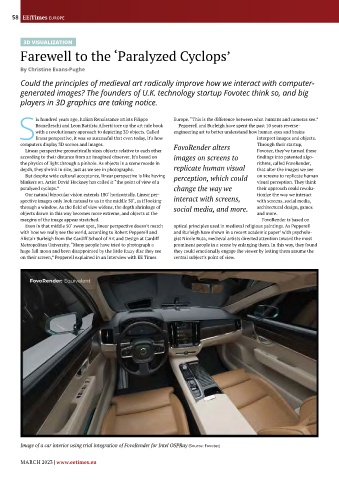
        Image of a car interior using trial integration of FovoRender for Intel OSPRay (Source: Fovotec)

        MARCH 2023 | www.eetimes.eu

