


Page 57 - 23_EETE_03
P. 57
EE|Times EUROPE   57

                                                        Human Digital Twins Are Set to Revolutionize Medicine


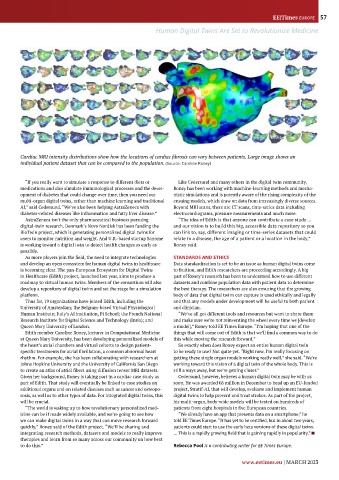
        Cardiac MRI intensity distributions show how the locations of cardiac fibrosis can vary between patients. Large image shows an
        individual patient dataset that can be compared to the population. (Source: Caroline Roney)


          “If you really want to simulate a response to different diets or   Like Cedersund and many others in the digital twin community,
        medications and also simulate immunological processes and the devel-  Roney has been working with machine-learning methods and mecha-
        opment of diabetes that could change over time, then you need our   nistic simulations and is patently aware of the rising complexity of the
        multi-organ digital twins, rather than machine learning and traditional   ensuing models, which draw on data from increasingly diverse sources.
        AI,” said Cedersund. “We’ve also been helping AstraZeneca with    Beyond MRI scans, there are CT scans, time-series data including
        diabetes-related diseases like inflammation and fatty liver disease.”  electrocardiograms, pressure measurements and much more.
          AstraZeneca isn’t the only pharmaceutical business pursuing   “The idea of Edith is that anyone can contribute a case study …
        digital-twin research. Denmark’s Novo Nordisk has been funding the   and our vision is to build this big, accessible data repository so you
        BioTwin project, which is generating personalized digital twins for   can link to, say, different imaging or time-series datasets that could
        users to monitor nutrition and weight. And U.K.-based startup Sanome   relate to a disease, the age of a patient or a location in the body,”
        is working toward a digital twin to detect health changes as early as   Roney said.
        possible.
          As more players join the field, the need to integrate technologies   STANDARDS AND ETHICS
        and develop an open ecosystem for human digital twins in healthcare   Data standardization is set to be an issue as human digital twins come
        is becoming clear. The pan-European Ecosystem for Digital Twins   to fruition, and Edith researchers are proceeding accordingly. A big
        in Healthcare (Edith) project, launched last year, aims to produce a   part of Roney’s research has been to understand how to use different
        roadmap to virtual human twins. Members of the consortium will also   datasets and combine population data with patient data to determine
        develop a repository of digital twins and set the stage for a simulation   the best therapy. The researchers are also ensuring that the growing
        platform.                                             body of data that digital twins can capture is used ethically and legally
          Thus far, 19 organizations have joined Edith, including the    and that any models under development will be useful to both patient
        University of Amsterdam; the Belgium-based Virtual Physiological   and clinician.
        Human Institute; Italy’s AI institution, Pi School; the French National   “We’ve all got different tools and resources but want to share them
        Research Institute for Digital Science and Technology (Inria); and   and make sure we’re not reinventing the wheel every time we [develop
        Queen Mary University of London.                      a model],” Roney told EE Times Europe. “I’m hoping that one of the
          Edith member Caroline Roney, lecturer in Computational Medicine   things that will come out of Edith is that we’ll find a common way to do
        at Queen Mary University, has been developing personalized models of   this while moving the research forward.”
        the heart’s atrial chambers and virtual cohorts to design patient-   So exactly when does Roney expect an entire human digital twin
        specific treatments for atrial fibrillation, a common abnormal heart   to be ready to use? Not quite yet. “Right now, I’m really focusing on
        rhythm. For example, she has been collaborating with researchers at   getting these single organ models working really well,” she said. “We’re
        Johns Hopkins University and the University of California San Diego   working toward this vision of a digital twin of the whole body. This is
        to create an atlas of atrial fibers using diffusion tensor MRI datasets.   still a ways away, but we’re getting closer.”
        Given her background, Roney is taking part in a cardiac case study as   Cedersund, however, believes a human digital twin may be with us
        part of Edith. That study will eventually be linked to case studies on   soon. He was awarded €6 million in December to head up an EU-funded
        additional organs and on related diseases such as cancer and osteopo-  project, Stratif-AI, that will develop, evaluate and implement human
        rosis, as well as to other types of data. For integrated digital twins, this   digital twins to help prevent and treat strokes. As part of the project,
        will be crucial.                                      his multi-organ, body-wide models will be tested on hundreds of
          “The world is waking up to how revolutionary personalized med-  patients from eight hospitals in five European countries.
        icine can be if made widely available, and we’re going to see how   “We already have an app that presents data on a smartphone,” he
        we can make digital twins in a way that can move research forward   told EE Times Europe. “It has yet to be certified, but in about two years,
        quickly,” Roney said of the Edith project. “We’ll be sharing and   patients could start to use the early beta versions of these digital twins.
        integrating research methods, datasets and models to really improve   … This is a rapidly growing field that is gaining rapidly in popularity.” ■
        therapies and learn from so many across our community on how best
        to do this.”                                          Rebecca Pool is a contributing writer for EE Times Europe.

                                                                                      www.eetimes.eu | MARCH 2023

