


Page 42 - EE Times Europe March 2022
P. 42
42 EE|Times EUROPE


            QUANTUM COMPUTING
           Quantum Computing Startup Opens London Lab

           in Quest to Build CMOS-Based Qubits


           By Nitin Dahad


                   uantum Motion, a startup devel-
                   oping scalable arrays of qubits and
                   fault-tolerant quantum computing
          Qarchitectures compatible with
           existing CMOS processes, has opened what it
           said is the largest independent quantum lab
           in the U.K.
             Based in Islington, North London, the new
           lab includes several specially configured dilu-
           tion refrigerators that provide cooling near
           absolute zero (–273°C) for the quantum chips,
           making it the most substantial low-
           temperature facility of any U.K. quantum lab
           established to date, according to the company.
           The facility will employ 25 full-time staff,
           including quantum theorists, physicists, and
           IC engineers, to realize Quantum Motion’s
           vision of truly scalable quantum computers
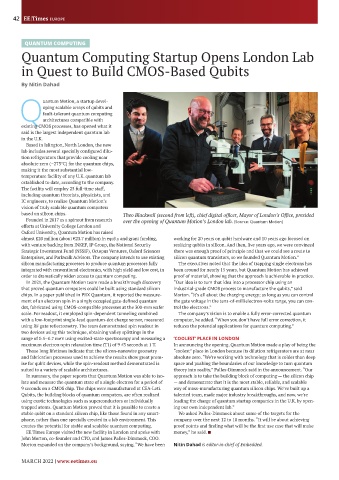
           based on silicon chips.             Theo Blackwell (second from left), chief digital officer, Mayor of London’s Office, presided
             Founded in 2017 as a spinout from research   over the opening of Quantum Motion’s London lab. (Source: Quantum Motion)
           efforts at University College London and
           Oxford University, Quantum Motion has raised
           almost £20 million (about €23.7 million) in equity and grant funding,   working for 20 years on qubit hardware and 10 years ago focused on
           with venture backing from INKEF, IP Group, the National Security   realizing qubits in silicon. And then, five years ago, we were convinced
           Strategic Investment Fund (NSSIF), Octopus Ventures, Oxford Sciences   there was enough proof of principle and that we could see a route to
           Enterprises, and Parkwalk Advisors. The company intends to use existing   silicon quantum transistors, so we founded Quantum Motion.”
           silicon manufacturing processes to produce quantum processors fully   The executives noted that the idea of trapping single electrons has
           integrated with conventional electronics, with high yield and low cost, in   been around for nearly 15 years, but Quantum Motion has achieved
           order to dramatically widen access to quantum computing.  proof of material, showing that the approach is achievable in practice.
             In 2021, the Quantum Motion team made a breakthrough discovery   “Our idea is to turn that idea into a processor chip using an
           that proved quantum computers could be built using standard silicon   industrial-grade CMOS process to manufacture the qubits,” said
           chips. In a paper published in PRX Quantum, it reported the measure-  Morton. “It’s all about the charging energy; as long as you can control
           ment of an electron spin in a singly occupied gate-defined quantum   the gate voltage in the tens-of-millielectron-volts range, you can con-
           dot, fabricated using CMOS-compatible processes at the 300-mm wafer   trol the electrons.”
           scale. For readout, it employed spin-dependent tunneling combined   The company’s vision is to enable a fully error-corrected quantum
           with a low-footprint single-lead quantum-dot charge sensor, measured   computer, he added. “When you don’t have full error correction, it
           using RF gate reflectometry. The team demonstrated spin readout in   reduces the potential applications for quantum computing.”
           two devices using this technique, obtaining valley splittings in the
           range of 0.5–0.7 meV using excited-state spectroscopy and measuring a   ‘COOLEST’ PLACE IN LONDON
           maximum electron-spin relaxation time (T1) of 9 ±3 seconds at 1 T.  In announcing the opening, Quantum Motion made a play of being the
             Those long lifetimes indicate that the silicon-nanowire geometry   “coolest” place in London because its dilution refrigerators are at near
           and fabrication processes used to achieve the results show great prom-  absolute zero. “We’re working with technology that is colder than deep
           ise for qubit devices, while the spin-readout method demonstrated is   space and pushing the boundaries of our knowledge to turn quantum
           suited to a variety of scalable architectures.        theory into reality,” Palles-Dimmock said in the announcement. “Our
             In summary, the paper reports that Quantum Motion was able to iso-  approach is to take the building block of computing — the silicon chip
           late and measure the quantum state of a single electron for a period of   — and demonstrate that it is the most stable, reliable, and scalable
           9 seconds on a CMOS chip. The chips were manufactured at CEA-Leti.   way of mass-manufacturing quantum silicon chips. We’ve built up a
           Qubits, the building blocks of quantum computers, are often realized   talented team, made major industry breakthroughs, and now, we’re
           using exotic technologies such as superconductors or individually   leading the charge of quantum startup companies in the U.K. by open-
           trapped atoms. Quantum Motion proved that it is possible to create a   ing our own independent lab.”
           stable qubit on a standard silicon chip, like those found in any smart-  We asked Palles-Dimmock about some of the targets for the
           phone, rather than one specially created in a lab environment. This   company over the next 12 to 18 months. “It will be about achieving
           creates the potential for stable and scalable quantum computing.  proof points and finding what will be the first use case that will make
             EE Times Europe visited the new facility in London and spoke with   money,” he said. ■
           John Morton, co-founder and CTO, and James Palles-Dimmock, COO.
           Morton expanded on the company’s background, saying, “We have been   Nitin Dahad is editor-in-chief of Embedded.

           MARCH 2022 | www.eetimes.eu

