


Page 37 - EE Times Europe March 2022
P. 37
EE|Times EUROPE   37

                               ‘AspenCore Guide to Silicon Carbide’: New Book Explores SiC in Smart Energy Era


             In the newest AspenCore guide, tech and market experts guide   charger and DC/DC applications as well as inverters, will exceed
           engineers and executives through the process of integrating SiC   US$2 billion by 2026.
           power devices into systems and applications. In his foreword to   The industry is betting that automotive platforms will serve as a
           the book, IEEE fellow Victor Veliadis, executive director and CTO   springboard for SiC’s expansion into more power electronics, enabling
           at PowerAmerica, calls it “a valuable reference for those engaged   technological maturation that will spawn higher device yields and
           directly in deploying SiC in the field and a comprehensive introduc-  more affordable devices. Our analysis looks at key players in the SiC
           tion for those making the transition from silicon.”   supply chain and examines the issues around SiC wafer supply and
             Veliadis writes that the book “covers basic material properties,   capacity.
           design, and fabrication of SiC devices as well as practical considerations   For smart-energy applications, SiC delivers 10× the dielectric
           for system insertion in high-volume applications in which SiC is dis-  strength of silicon, thereby enabling devices that operate at higher
           placing the dominant Si technology. The book also provides a detailed   voltage while meeting operational requirements for charging
           market analysis, with insights into SiC power device market dynamics   infrastructure and smart grids. SiC’s higher switching frequency lets
           and emerging trends. It is therefore a compelling read for business   designers reduce the physical size of magnets, filters, and transform-
           professionals and practicing engineers alike.”        ers and allow for significant improvements in motor efficiency.
             SiC devices are being deployed in high-voltage power converters   In both automotive and industrial settings, energy solutions based
           with rigorous size, weight, and efficiency requirements. On-state   on SiC materials are increasing. SiC wafer production remains a far
           resistance and switching losses are significantly reduced with SiC, and   more complicated process than that for silicon wafers. With demand
           the material has nearly 3× the thermal conductivity of silicon, allowing   for SiC devices growing, manufacturers must find wafer suppliers.
           components to dissipate heat more quickly. That’s significant as   Our book includes contributions from executives at key semiconduc-
           Si-based devices shrink in size.                      tor companies involved in SiC production, including their perspectives
             The bandgap energy of silicon carbide is greater than that of silicon   on SiC technology’s future. The discussion includes likely market
           (3.2 eV, or about 3× higher than silicon’s
           1.1 eV). Higher breakdown voltages and
           efficiency, along with better thermal stability
           at high temperatures, are possible because
           more energy is required to excite a valence
           electron in the semiconductor’s conductive
           band. Smaller circuits and less weight, as well
           as lower total power usage, are all advantages
           of adopting SiC technology in inverters. SiC
           MOSFETs can operate at a significantly greater
           switching frequency, allowing smaller inverter
           components. SiC power semiconductors may
           also function at greater voltages and currents
           than ordinary silicon power semiconductors,
           resulting in more power.
             The guide covers WBG markets, technology,
           and applications. Technology experts provide
           insights into markets benefiting from the
           superior performance of SiC power devices and
           discuss the technical foundation underpin-
           ning SiC-based design, fabrication, and circuit
           implementation. Subsequent chapters cover
           major SiC device applications, including elec-
           tric vehicles, renewable energy, motor control,
           aerospace, and defense.
             “Each chapter is a practical overview of its
           subject matter and a must-read for anyone
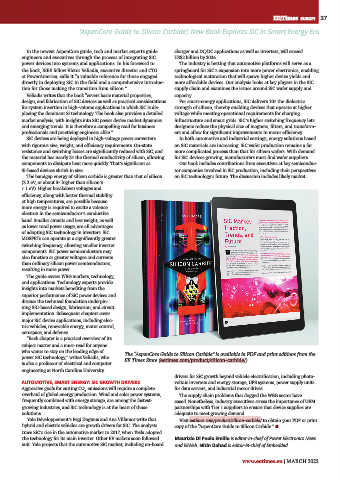
           who wants to stay on the leading edge of   The “AspenCore Guide to Silicon Carbide” is available in PDF and print editions from the
           power SiC technology,” writes Veliadis, who   EE Times Store (eetimes.com/product/silicon-carbide/).
           is also a professor of electrical and computer
           engineering at North Carolina University.
                                                                 drivers for SiC growth beyond vehicle electrification, including photo-
           AUTOMOTIVE, SMART ENERGY: SiC GROWTH DRIVERS          voltaic inverters and energy storage, UPS systems, power supply units
           Aggressive goals for cutting CO  emissions will require a complete   for data servers, and industrial motor drives.
                                 2
           overhaul of global energy production. Wind and solar power systems,   The supply chain problems that dogged the WBG sector have
           frequently combined with energy storage, are among the fastest-   eased. Nonetheless, industry executives stress the importance of OEM
           growing industries, and SiC technology is at the heart of those   partnerships with Tier 1 suppliers to ensure that device supplies are
           solutions.                                            adequate to meet growing demand.
             Yole Développement’s Ezgi Dogmus and Ana Villamor write that   Visit eetimes.com/product/silicon-carbide/ to obtain your PDF or print
           hybrid and electric vehicles are growth drivers for SiC. The analysts   copy of the “AspenCore Guide to Silicon Carbide.” ■
           trace SiC’s rise in the automotive market to 2017, when Tesla adopted
           the technology for its main inverter. Other EV makers soon followed   Maurizio Di Paolo Emilio is editor-in-chief of Power Electronics News
           suit. Yole projects that the automotive SiC market, including on-board   and EEWeb. Nitin Dahad is editor-in-chief of Embedded.

                                                                                         www.eetimes.eu | MARCH 2022

