


Page 44 - EE Times Europe March 2022
P. 44
44 EE|Times EUROPE

           Inference Sensing and In-Memory Computing Chip Startup Claims 20 TOPS/W


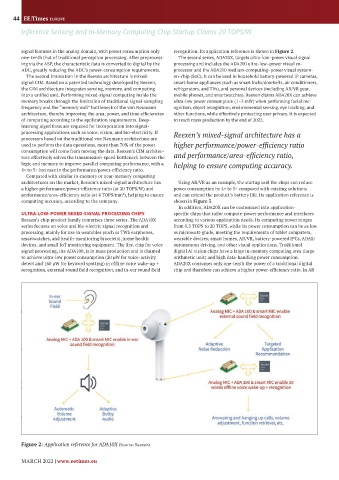
           signal features in the analog domain, with power consumption only   recognition. Its application reference is shown in Figure 2.
           one-tenth that of traditional perception processing. After preprocess-  The second series, ADA20X, targets ultra-low–power visual signal
           ing via the ASP, the characteristic data is converted to digital by the   processing and includes the ADA200 ultra-low–power visual co-
           ADC, greatly reducing the ADC’s power-consumption requirements.  processor and the ADA210 medium-computing–power visual system-
             The second innovation in the Reexen architecture is mixed-   on-chip (SoC). It can be used in household battery-powered IP cameras,
           signal CIM. Based on a patented technology developed by Reexen,   smart-home appliances (such as smart locks/doorbells, air conditioners,
           the CIM architecture integrates sensing, memory, and computing   refrigerators, and TVs), and personal devices (including AR/VR gear,
           into a unified unit. Performing mixed-signal computing inside the   mobile phones, and smartwatches). Reexen claims ADA20X can achieve
           memory breaks through the limitation of traditional signal-sampling   ultra-low power consumption (1–3 mW) when performing facial rec-
           frequency and the “memory wall” bottleneck of the von Neumann   ognition, object recognition, environmental sensing, eye tracking, and
           architecture, thereby improving the area, power, and time efficiencies   other functions, while effectively protecting user privacy. It is expected
           of computing according to the application requirements. Deep-   to reach mass production by the end of 2022.
           learning algorithms are required for incorporation into signal-
           processing applications such as voice, vision, and bio-electricity. If   Reexen’s mixed-signal architecture has a
           processors based on the traditional von Neumann architecture are
           used to perform the data operations, more than 70% of the power   higher performance/power-efficiency ratio
           consumption will come from moving the data. Reexen’s CIM architec-
           ture effectively solves the transmission-speed bottleneck between the   and performance/area-efficiency ratio,
           logic and memory to improve parallel computing performance, with a   helping to ensure computing accuracy.
           4× to 5× increase in the performance/power-efficiency ratio.
             Compared with similar in-memory or near-memory computing
           architectures on the market, Reexen’s mixed-signal architecture has   Using AR/VR as an example, the startup said the chips can reduce
           a higher performance/power-efficiency ratio (at 20 TOPS/W) and   power consumption by 4× to 5× compared with existing solutions
           performance/area-efficiency ratio (at 4 TOPS/mm ), helping to ensure   and can extend the product’s battery life. Its application reference is
                                               2
           computing accuracy, according to the company.         shown in Figure 3.
                                                                   In addition, ADA20X can be customized into application-
           ULTRA-LOW–POWER MIXED-SIGNAL PROCESSING CHIPS         specific chips that tailor compute-power performance and interfaces
           Reexen’s chip product family comprises three series. The ADA10X   according to various application needs. Its computing power ranges
           series focuses on voice and bio-electric signal recognition and   from 0.3 TOPS to 20 TOPS, while its power consumption can be as low
           processing, mainly for use in wearables (such as TWS earphones,   as microwatt-grade, meeting the requirements of tablet computers,
           smartwatches, and health-monitoring bracelets), home health   wearable devices, smart homes, AR/VR, battery-powered IPCs, ADAS/
           devices, and small IoT monitoring equipment. The first chip for voice   autonomous driving, and other visual applications. Traditional
           signal processing, the ADA100, is in mass production and is claimed   digital AI vision chips have a large in-memory computing area (large
           to achieve ultra-low power consumption (20 µW for voice-activity   arithmetic unit) and high data-handling power consumption.
           detect and 160 µW for keyword spotting) in offline voice wake-up +   ADA20X consumes only one-tenth the power of a traditional digital
           recognition, external sound field recognition, and in-ear sound field   chip and therefore can achieve a higher power-efficiency ratio. In AR


           Figure 2: Application reference for ADA10X (Source: Reexen)

           MARCH 2022 | www.eetimes.eu

