


Page 32 - EETEurope FlipBook February
P. 32
32 EE|Times EUROPE — Power Electronics


                 POWER ELECTRONICS

               Miniature Current


               Transformers Keep Pace


               with GaN


               BY GEORGE SLAMA, Senior Application Engineer, Würth Elektronik


                        s we begin to realize all the promises made to
                        us by the proponents of gallium nitride and
                        silicon carbide devices — the promises of faster,
               Asmaller, and cheaper (someday) power conver-
               sion devices — it’s important to note similar advances in
               the related passive components. For a long time, higher
               operating frequency meant smaller magnetics and capaci-
               tors simply because the amount of energy storage required
               per cycle decreased. For the same amount of total power,
               the more units of energy per second, the smaller the unit
               needed to be.

                 Current transformers are used for    allows for high-side sensing; their power dis-  turns ratios. Though the common turns ratios
               control, protection, detection, or measure-  sipation is very low compared with resistors,   are the same as for larger current transform-
               ment in power supplies. Current mode control   especially at large currents; they have a high   ers, the small size significantly lowers winding
               requires measuring the peak currents and   output signal, which provides better noise   self-capacitance, extending the operating fre-
               responding accordingly. Protection is usually   immunity; the circuitry is simple, with no   quency range well into the megahertz region,
               related to overcurrent limits; detection is   need for an operational amplifier; the single   as shown in Figure 2.
               knowing that a load or power supply is using   primary can be integrated into the package;
               current; and, finally, measurement is used   they are rugged and compact; and they are   Current transformers provide
               when power consumption is needed.   SMT-ready.
                 Current transformers have many advan-  Current transformers are now available in   galvanic isolation, low power
               tages over other sensing methods. They   a compact size based on EE5 and EE4.4 cores   dissipation compared with
               provide galvanic isolation, which easily   like the WE-CST series, with many standard
                                                                                       resistors, a high output signal,
                                                                                       simple circuitry, and a rugged,
                       RP       LLKG                            RS
                                                                                       compact, SMT-ready design.


                            IP                                                           The downside is lower magnetizing induc-
                                                                                       tance, which affects the low-end operating
                                                       LM     RC    CS           RB
                                                                                       frequency and must be considered when
                                                                                       choosing a part for an application. As seen in
                                                                                       Figure 3, magnetizing current (I ) and core
                                                                                                              m
                                            1:n                                        loss (I ) combine to form the exciting current
                                                                                           c
                                           ideal                                       (I ), which diverts current away from the
                                                                                        ex
                                                                                       burden resistor used to convert the current
                                                                                       into a voltage for measurement. This sets the
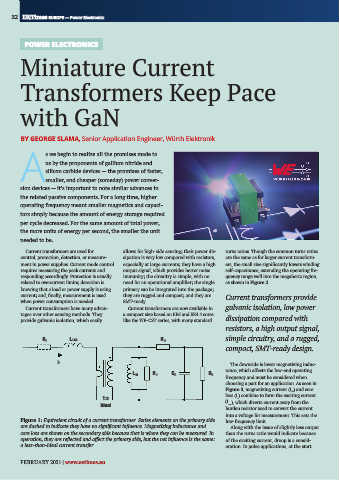
               Figure 1: Equivalent circuit of a current transformer. Series elements on the primary side   low-frequency limit.
                                                                       S20 106
               are dashed to indicate they have no significant influence. Magnetizing inductance and   Along with the issue of slightly less output
               core loss are shown on the secondary side because that is where they can be measured. In   than the turns ratio would indicate because
               operation, they are reflected and affect the primary side, but the net influence is the same:   of the exciting current, droop is a consid-
               a less-than-ideal current transfer.                                     eration. In pulse applications, at the start

               FEBRUARY 2021 | www.eetimes.eu

