


Page 56 - EE Times Europe Magazine | February 2020
P. 56
54 EE|Times EUROPE


              AUTOMOTIVE POWER
            Galvanic Isolation in EV and HEV Applications


            By Maurizio Di Paolo Emilio


                  he worldwide proliferation of electric
                  and hybrid electric vehicles (EVs and
                  HEVs), which must withstand higher
            T operating voltages and currents than
            gasoline-powered vehicles, has underscored
            the importance of electrical isolation for
            automotive design. Electrifi cation of the car
            has mandated the use of high-power devices
            — notably batteries, inverters, and regenera-
            tive braking systems — whose interfacing with
            digital control circuits requires the adoption
            of appropriate galvanic isolation techniques.
              Electrical, or galvanic, isolation is the con-
            dition in which no direct current circulation
            takes place between two points of differing
            electrical potential. More precisely, it is not
            possible to move charge carriers from one
            point to another while electrical energy (or
            a signal) can still be exchanged by other
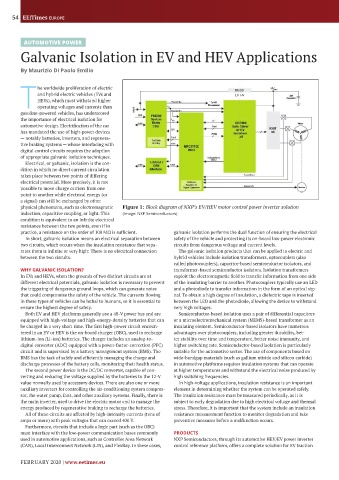
            physical phenomena, such as electromagnetic   Figure 1: Block diagram of NXP’s EV/HEV motor control power inverter solution
            induction, capacitive coupling, or light. This   (Image: NXP Semiconductors)
            condition is equivalent to an infi nite electrical
            resistance between the two points, even if in
            practice, a resistance on the order of 100 M  is suffi cient.   galvanic isolation performs the dual function of ensuring the electrical
              In short, galvanic isolation means an electrical separation between   safety of the vehicle and protecting its on-board low-power electronic
            two circuits, which occurs when the insulation resistance that sepa-  circuits from dangerous voltage and current levels.
            rates them is infi nite or very high  There is no electrical connection   The galvanic isolation products that can be applied to electric and
            between the two circuits.                             hybrid vehicles include isolation transformers, optocouplers (also
                                                                  called photocouplers), capacitor-based semiconductor isolators, and
            WHY GALVANIC ISOLATION?                               transformer-based semiconductor isolators. Isolation transformers
            In EVs and HEVs, when the grounds of two distinct circuits are at   exploit the electromagnetic fi eld to transfer information from one side
            different electrical potentials, galvanic isolation is necessary to prevent   of the insulating barrier to another. Photocouplers typically use an LED
            the triggering of dangerous ground loops, which can generate noise   and a photodiode to transfer information in the form of an optical sig-
            that could compromise the safety of the vehicle. The currents fl owing   nal. To obtain a high degree of insulation, a dielectric tape is inserted
            in these types of vehicles can be lethal to humans, so it is essential to   between the LED and the photodiode, allowing the device to withstand
            ensure the highest degree of safety.                  very high voltages.
              Both EV and HEV platforms generally use a 48-V power bus and are   Semiconductor-based isolation uses a pair of differential capacitors
            equipped with high-voltage and high-energy-density batteries that can   or a microelectromechanical system (MEMS)-based transformer as an
            be charged in a very short time. The fi rst high-power circuit encoun-  insulating element. Semiconductor-based isolators have numerous
            tered in an EV or HEV is the on-board charger (OBC), used to recharge   advantages over photocouplers, including greater durability, bet-
            lithium-ion (Li-ion) batteries. The charger includes an analog-to-  ter stability over time and temperature, better noise immunity, and
            digital converter (ADC) equipped with a power-factor-correction (PFC)   higher switching rate. Semiconductor-based isolation is particularly
            circuit and is supervised by a battery management system (BMS). The   suitable for the automotive sector. The use of components based on
            BMS has the task of safely and effi ciently managing the charge and   wide-bandgap materials (such as gallium nitride and silicon carbide)
            discharge processes of the battery cells, monitoring their health status.   in automotive platforms requires insulation systems that can operate
              The second power device is the DC/DC converter, capable of con-  at higher temperatures and withstand the electrical noise produced by
            verting and reducing the voltage supplied by the batteries to the 12-V   high switching frequencies.
            value normally used by accessory devices. There are also one or more   In high-voltage applications, insulation resistance is an important
            auxiliary inverters for controlling the air-conditioning system compres-  element in determining whether the system can be operated safely.
            sor, the water pump, fans, and other auxiliary systems. Finally, there is   The insulation resistance must be measured periodically, as it is
            the main inverter, used to drive the electric motor and to manage the   subject to early degradation due to high electrical voltage and thermal
            energy produced by regenerative braking to recharge the batteries.   stress. Therefore, it is important that the system include an insulation
              All of these circuits are affected by high-intensity currents (tens of   resistance measurement function to monitor degradation and take
            amps or more) with peak voltages that can exceed 400 V.  preventive measures before a malfunction occurs.
              Furthermore, circuits that include a logic part (such as the OBC)
            must interface with the low-power communication buses commonly   PRODUCTS
            used in automotive applications, such as Controller Area Network   NXP Semiconductors, through its automotive HEV/EV power inverter
            (CAN), Local Interconnect Network (LIN), and FlexRay. In these cases,   control reference platform, offers a complete solution for EV traction

            FEBRUARY 2020 | www.eetimes.eu

