


Page 33 - PEN eBook NOVEMBER 2022
P. 33
SEMICONDUCTORS                                                                                   : SEMICONDUCTORS

           For a specific rated voltage, the thickness of the drift   mentioned, GaN is the only viable wide-bandgap
          layer is inversely proportional to the critical electric   alternative to silicon in low-power applications, as SiC
          field. This implies that GaN and SiC devices of a   operation is impractical at voltages below 650 V.
          particular voltage capability have drift layers that are
          10× thinner than those of silicon devices. These factors   GALLIUM NITRIDE AND SILICON
          drive design changes and have major implications in   CARBIDE
          semiconductor design.                                GaN enables a power-factor–correction (PFC)
                                                              technology known as “totem-pole bridgeless PFC
           Due to their thinner drift layers, SiC devices are   topology.” On the other hand, a traditional silicon boost
          smaller in size, which decreases their capacitance.   solution would have a diode bridge where two of the
          These devices can therefore efficiently switch at   diodes are constantly on. This would contribute to
          frequencies much higher than what is possible with   significant losses but is mitigated by GaN due to its
          silicon. As a result of the higher switching frequency,   essentially zero reverse recovery. 100-V GaN devices are
          the size of passive components and magnetic devices   also being deployed at data centers, as server racks are
          like inductors also decreases. This leads to a significant   increasingly moving toward 48 V. Furthermore,
          reduction in the overall size of the system, which   650-V GaN devices can also be deployed and run
          increases its power density. Furthermore, the large   for PFC circuitry. SiC is suitable for higher-power
          SiC bandgap and high thermal conductivity allow for   applications than what is possible using GaN and is
          high temperature operation with simplified cooling   available in voltages ranging from 650 V to 3.3 kV,
          management, further decreasing system weight and    with higher-voltage devices being developed.
          volume.
                                                               Stephen Russell, subject matter expert for power
           None of this is to say that either SiC or GaN is   devices at Tech Insights, said during a company
          superior or that silicon is obsolete. The choice of   webinar, “Gallium nitride has truly found its killer app
          semiconductor material to be used will depend on    in replacing silicon and USB-C chargers for mobile
          the specifications of the application in which they are   devices. 2021 [was] a watershed year in market
          deployed. Silicon is still a strong contender in devices   acceptance, and we only expect this momentum to
          rated from 15 V to 650 V while also being much cheaper   continue. Gallium nitride’s real advantage, however,
          and more reliable, whereas GaN has been gaining     is its switching; it is the only viable wide-bandgap
                                                              replacement for silicon at voltages less than 600 V.”
          popularity in low-power applications like mobile
 What Does the Future   chargers and similar charging systems. As previously


 Hold for WBG Devices?


 By Maurizio Di Paolo Emilio, editor-in-chief of Power Electronics News


 Silicon carbide and gallium nitride have witnessed   increasing amount of EVs that are being introduced
 increasing success in the semiconductor device market   into the market.
 in recent years. GaN is now used in mobile device
 chargers and charging systems. Companies like Apple,   Their popularity begs the question: What is so special
 Samsung, and Xiaomi have chosen GaN-based chargers   about these new semiconductor materials, and why are
 that provide high power densities while maintaining,   they being looked at as alternatives to silicon?
 or even decreasing, the weight of these components.
 These chargers utilize power GaN high-electron–  As explained by Victor Veliadis in his July 28, 2022,
 mobility transistor (HEMT) chips offered by companies   PSMA webinar, “SiC Power Technology Status and
 like GaN Systems and Navitas Semiconductor.  Barriers to Overcome,” “SiC and GaN materials have
 a critical electric field that is about 10× higher than
 On the other hand, SiC devices have primarily been   that of silicon, with a bandgap that is 3× higher. In a
 used in the field of electric mobility. In 2017, electric-  semiconductor system, the drift layer is what holds its
 vehicle manufacturers like Tesla chose to use SiC-  rated voltage, which makes the thickness and doping
 based motor controllers, which boosted the efficiency   levels of this layer determine the voltage capability of
 of their systems. This has kickstarted a race toward   the device.”
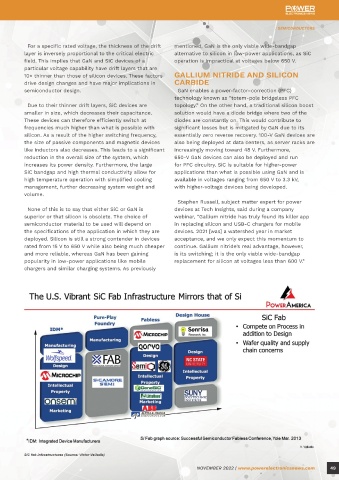
 developing high volumes of SiC devices to meet the   SiC fab infrastructures (Source: Victor Veliadis)

 48  NOVEMBER 2022 | www.powerelectronicsnews.com                     NOVEMBER 2022 | www.powerelectronicsnews.com   49

