


Page 31 - PEN eBook NOVEMBER 2022
P. 31
DESIGN                                                                                                   DESIGN

                                                               Last week, Empower Semiconductor announced that
                                                              it has expanded its E-CAP family of silicon capacitors
                                                              with new technologies that offer further breakthroughs
                                                              in density and performance. The latest E-CAP solutions
                                                              offer densities of 1.1 µF/mm . In addition to the density,
                                                                                      2
                                                              thickness levels can be achieved below 50 µm in
                                                              overall height. Multiple matched capacitance values
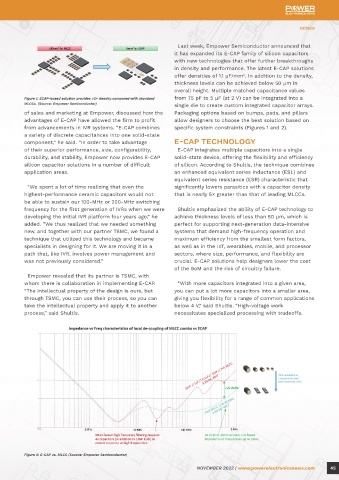
          Figure 1: ECAP-based solution provides >5× density compared with standard   from 75 pF to 5 µF (at 2 V) can be integrated into a
          MLCCs. (Source: Empower Semiconductor)              single die to create custom integrated capacitor arrays.
          of sales and marketing at Empower, discussed how the   Packaging options based on bumps, pads, and pillars
          advantages of E-CAP have allowed the firm to profit   allow designers to choose the best solution based on
          from advancements in IVR systems. “E-CAP combines   specific system constraints (Figures 1 and 2).
          a variety of discrete capacitances into one solid-state
          component,” he said. “In order to take advantage    E-CAP TECHNOLOGY
          of their superior performance, size, configurability,   solid-state device, offering the flexibility and efficiency
                                                               E-CAP integrates multiple capacitors into a single
          durability, and stability, Empower now provides E-CAP
 Integrating Multiple   silicon capacitor solutions in a number of difficult   of silicon. According to Shultis, the technique combines
                                                              an enhanced equivalent series inductance (ESL) and
          application areas.
 Discrete Capacitances   highest-performance ceramic capacitors would not   equivalent series resistance (ESR) characteristic that
           “We spent a lot of time realizing that even the
                                                              significantly lowers parasitics with a capacitor density
                                                              that is nearly 5× greater than that of leading MLCCs.
 Into a Solid-State   be able to sustain our 100-MHz or 200-MHz switching   achieve thickness levels of less than 50 µm, which is
                                                               Shultis emphasized the ability of E-CAP technology to
          frequency for the first generation of IVRs when we were
          developing the initial IVR platform four years ago,” he
                                                              perfect for supporting next-generation data-intensive
          added. “We thus realized that we needed something
 Device   new, and together with our partner TSMC, we found a   systems that demand high-frequency operation and
          technique that utilized this technology and became
                                                              maximum efficiency from the smallest form factors,
          specialists in designing for it. We are moving it in a
          path that, like IVR, involves power management and   as well as in the IoT, wearables, mobile, and processor
                                                              sectors, where size, performance, and flexibility are
 Although semiconductor switching devices have received   was not previously considered.”  crucial. E-CAP solutions help designers lower the cost
 a lot of attention to make these advances, capacitance   Empower revealed that its partner is TSMC, with   of the BoM and the risk of circuitry failure.
                                                               “With more capacitors integrated into a given area,
 may also be a significant design component in helping   whom there is collaboration in implementing E-CAP.   you can put a lot more capacitors into a smaller area,
          “The intellectual property of the design is ours, but
 engineers satisfy energy storage, filtering, leveling, and   through TSMC, you can use their process, so you can   giving you flexibility for a range of common applications
                                                              below 4 V,” said Shultis. “High-voltage work
          take the intellectual property and apply it to another
 tuning needs.  process,” said Shultis.                       necessitates specialized processing with tradeoffs.


 By Maurizio Di Paolo Emilio, editor-in-chief of Power Electronics News


 Power system designers are constantly under   made up of layers of metal electrodes and ceramic
 pressure to attain larger power densities and improved   dielectrics that alternate. High temperatures are
 conversion efficiencies, whether it is for data servers   used during the fabrication of the laminated layers of
 for the internet of things or data centers. Although   MLCCs to create a sintered, volumetrically effective
 semiconductor switching devices have received a lot of   capacitive device. A conductive termination barrier is
 attention to make these advances, capacitors may also   then incorporated at the exposed ends to complete the
 be a significant design component in helping engineers   connection.
 satisfy energy storage, filtering, leveling, and tuning
 needs.  Empower Semiconductor (Empower) developed
 its own 220-nF capacitor technology (E-CAP) to
 However, capacitor development has not kept pace   complement its series of integrated voltage
 with changes seen in the semiconductor world and   regulators (IVRs) after recognizing the drawbacks
 even leading technologies such as multilayer ceramic   of traditional capacitors. In an interview with Power
 capacitors (MLCCs). MLCCs are monolithic electronics   Electronics News, Steve Shultis, senior vice president   Figure 2: E-CAP vs. MLCC (Source: Empower Semiconductor)

 44  NOVEMBER 2022 | www.powerelectronicsnews.com                     NOVEMBER 2022 | www.powerelectronicsnews.com   45

