


Page 27 - PEN eBook NOVEMBER 2022
P. 27
SEMICONDUCTORS                                                                                    SEMICONDUCTORS

          conduction and switching losses affect the overall
          efficiency. In hard switching, turn-on losses can
          dominate due to reverse recovery and junction
          capacitance charge. The loss from input gate
          capacitance switching-node charge/discharge also has
          a major role at high frequencies. The high di/dt and
          dV/dt from high-frequency HS also place
          third-quadrant hard-commutation requirements on the
          device, which can be another loss component. Within
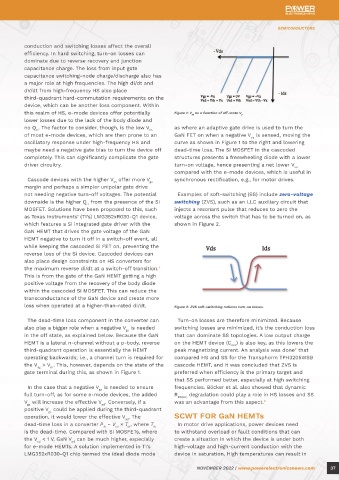
          this realm of HS, e-mode devices offer potentially   Figure 1: V sd  as a function of off-state V g
          lower losses due to the lack of the body diode and
          no Q . The factor to consider, though, is the low V    as where an adaptive gate drive is used to turn the
              rr
                                                     th
          of most e-mode devices, which are then prone to an   GaN FET on when a negative V  is sensed, moving the
                                                                                         ds
          oscillatory response under high-frequency HS and    curve as shown in Figure 1 to the right and lowering
          maybe need a negative gate bias to turn the device off   dead-time loss. The Si MOSFET in the cascoded
          completely. This can significantly complicate the gate   structures presents a freewheeling diode with a lower
          driver circuitry.                                   turn-on voltage, hence presenting a net lower V
                                                                                                        sd
                                                              compared with the e-mode devices, which is useful in
 GaN HEMTs: Device   margin and perhaps a simpler unipolar gate drive  gs  synchronous rectification, e.g., for motor drives.
           Cascode devices with the higher V  offer more V
                                         th
                                                               Examples of soft-switching (SS) include zero-voltage
 Characteristics and   not needing negative turn-off voltages. The potential   switching (ZVS), such as an LLC auxiliary circuit that
          downside is the higher Q  from the presence of the Si
                               rr
                                                              injects a resonant pulse that reduces to zero the
          MOSFET. Solutions have been proposed to this, such
 Application Tradeoffs  as Texas Instruments’ (TI’s) LMG352xR030-Q1 device,   voltage across the switch that has to be turned on, as
                                                              shown in Figure 2.
          which features a Si integrated gate driver with the
          GaN HEMT that drives the gate voltage of the GaN
          HEMT negative to turn it off in a switch-off event, all
 By Sonu Daryanani, contributing writer for Power Electronics News  while keeping the cascoded Si FET on, preventing the
          reverse loss of the Si device. Cascoded devices can
          also place design constraints on HS converters for
 Gallium nitride HEMT devices are at the forefront   achieved, and Transphorm, Nexperia, and others   the maximum reverse di/dt at a switch-off transition.
                                                         1
 of creating new opportunities as well as replacing   offer some examples of this.  This is from the gate of the GaN HEMT getting a high
 existing silicon-based designs in a wide range of   positive voltage from the recovery of the body diode
 power-conversion and power-delivery applications.   E-mode devices have the advantage of using some   within the cascoded Si MOSFET. This can reduce the
 In this article, we will review some of the key device   of the intrinsic benefits of the GaN HEMT, such as no   transconductance of the GaN device and create more
 characteristics of some of the more widely available   reverse-recovery loss due to lack of a p-n junction in   loss when operated at a higher-than-rated di/dt.  Figure 2: ZVS soft-switching reduces turn-on losses.
 HEMTs and try to highlight some of the tradeoffs on   the drain/source, as well as simpler/lower parasitics
 each one.  from not having an additional device in series. One big   The dead-time loss component in the converter can   Turn-on losses are therefore minimized. Because
 disadvantage, however, is the poor margin for gate drive   also play a bigger role when a negative V  is needed   switching losses are minimized, it’s the conduction loss
                                             gs
 The two most widely used approaches to GaN HEMTs   and a susceptibility to gate noise from the low V .  in the off state, as explained below. Because the GaN   that can dominate SS topologies. A low output charge
 th
 for power applications are:  HEMT is a lateral n-channel without a p-body, reverse   on the HEMT device (C ) is also key, as this lowers the
                                                                                  oss
 The cascode approach solves the poor gate margin   third-quadrant operation is essentially the HEMT   peak magnetizing current. An analysis was done  that
                                                                                                         2
 ▶  The e-mode approach, where the device   of the e-mode and offers a more robust gate. This,   operating backwards; i.e., a channel turn is required for   compared HS and SS for the Transphorm TPH3205WSB
 could be formed with a p-GaN Schottky gate   however, is at the expense of potentially having higher   the V  > V . This, however, depends on the state of the   cascode HEMT, and it was concluded that ZVS is
              dg
                   th
 and result in a V  of about 1.7 V. Examples of   switching losses from reverse recovery (Q ) in the Si FET.   gate terminal during this, as shown in Figure 1.  preferred when efficiency is the primary target and
 rr
 t
 this approach would be devices offered by   Approaches taken to mitigate this are discussed later.  that SS performed better, especially at high switching
 GaN Systems, GaN Power International, and   In the case that a negative V  is needed to ensure   frequencies. Böcker et al. also showed that dynamic
                                    gs
 Innoscience, to name just a few. A notable   Some important application performance examples   full turn-off, as for some e-mode devices, the added   R DS(on)  degradation could play a role in HS losses and SS
 exception to the relatively low V  for e-mode   are listed below and a comparison is made between   V  will increase the effective V . Conversely, if a   was an advantage from this aspect. 3
 t
                                     sd
           gs
 devices is the offering from Cambridge GaN   the two device approaches listed above.  positive V  could be applied during the third-quadrant
                  gs
 Devices, which offers >2-V e-mode devices   operation, it would lower the effective V . The   SCWT FOR GaN HEMTs
                                             sd
 through some innovative design approaches.  HARD-/SOFT-SWITCHING   dead-time loss in a converter P  ~ V  × T , where T    In motor drive applications, power devices need
                                                       dt
                                     dt
                                         sd
                                              dt
 CHARACTERISTICS OF GaN HEMTs  is the dead-time. Compared with Si MOSFETs, where   to withstand overload or fault conditions that can
 ▶  The cascode approach, where a low-voltage   Examples of hard switching (HS) include synchronous   the V  < 1 V, GaN V  can be much higher, especially   create a situation in which the device is under both
              sd
                          sd
 Si MOSFET is essentially placed in series   buck/boost converters and continuous-conduction–  for e-mode HEMTs. A solution implemented in TI’s   high-voltage and high-current conduction with the
 and creates the gate drive. Higher V  can be   mode totem-pole PFC AC/DC converters. Both   LMG352xR030-Q1 chip termed the ideal diode mode   device in saturation. High temperatures can result in
 t
 36  NOVEMBER 2022 | www.powerelectronicsnews.com                     NOVEMBER 2022 | www.powerelectronicsnews.com   37

