


Page 11 - PEN eBook May 2022
P. 11
Cover Story – Design                                                                 Cover Story – Design


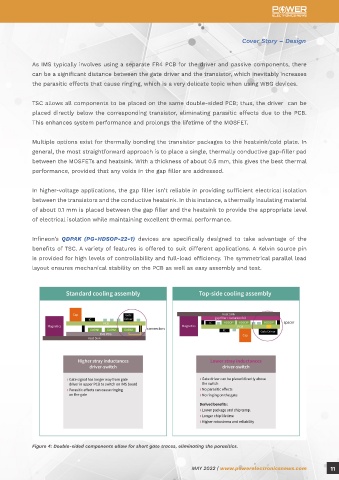
            As IMS typically involves using a separate FR4 PCB for the driver and passive components, there
            can be a significant distance between the gate driver and the transistor, which inevitably increases
            the parasitic effects that cause ringing, which is a very delicate topic when using WBG devices.


            TSC allows all components to be placed on the same double-sided PCB; thus, the driver  can be
            placed directly below the corresponding transistor, eliminating parasitic effects due to the PCB.
            This enhances system performance and prolongs the lifetime of the MOSFET.


            Multiple options exist for thermally bonding the transistor packages to the heatsink/cold plate. In
            general, the most straightforward approach is to place a single, thermally conductive gap-filler pad
            between the MOSFETs and heatsink. With a thickness of about 0.5 mm, this gives the best thermal
            performance, provided that any voids in the gap filler are addressed.


            In higher-voltage applications, the gap filler isn’t reliable in providing sufficient electrical isolation
            between the transistors and the conductive heatsink. In this instance, a thermally insulating material
 Figure 3: TSC permits double-sided component placement, allowing for a doubling of power density.
            of about 0.1 mm is placed between the gap filler and the heatsink to provide the appropriate level
 NEW THERMAL DESIGN THROUGH INNOVATIVE PACKAGE AND   of electrical isolation while maintaining excellent thermal performance.

 COOLING APPROACH
 While acknowledging the benefits of WBG technology, designers must also be aware that improved   Infineon’s  QDPAK (PG-HDSOP-22-1)  devices  are  specifically  designed to take  advantage  of the

 thermal performance plays a crucial role in achieving these important goals.  benefits of TSC. A variety of features is offered to suit different applications. A Kelvin source pin
            is provided for high levels of controllability and full-load efficiency. The symmetrical parallel lead
 In current SMD designs, the conduction path for the heat is downward, through the legs of the   layout ensures mechanical stability on the PCB as well as easy assembly and test.
 component into the PCB, which is bonded to a heatsink. In challenging applications, the power
 components  may  be  mounted  on  an  insulated  metal  substrate  (IMS),  which  improves  thermal
 performance, as it is a better conductor of heat than standard FR4 materials. However, the natural
 inclination of heat is to rise, making bottom-side cooling (BSC) seem somewhat counterintuitive.


 Through innovative packaging, Infineon has developed top-side–cooled (TSC) discrete semiconductors

 and ICs. This concept not only takes advantage of the natural upward flow of heat but delivers many
 additional benefits that are advantageous to the OBC design and other similar applications.


 In BSC, a cold plate/heatsink is typically attached to the bottom side of the PCB/IMS to dissipate
 heat. This precludes the placement of components on one side, reducing power density by a factor
 of 2. Also, the semiconductor devices are thermally bonded to the PCB, which means they will
 operate at the same temperature. As the glass transition temperature of the FR4 PCB is lower than

 the operating temperature of many WBG devices, they cannot be used to their full potential.


 With the  cold  plate  bonded to the top side  of the  power  components, these  issues  are  easily
 addressed, allowing for components to be placed on both sides, and WBG devices can be used over
 their entire operating temperature range.
            Figure 4: Double-sided components allow for short gate traces, eliminating the parasitics.


 10  MAY 2022 | www.powerelectronicsnews.com                        MAY 2022 | www.powerelectronicsnews.com          11

