


Page 9 - PEN eBook May 2022
P. 9
Cover Story – Design                                                                 Cover Story – Design


 the traction battery, thereby reducing charging time.


 3.  The increase in efficiency is closely related to the first two trends. It is impossible to achieve

 higher power classes at higher power density without having higher-efficiency power converters.
 Similarly, extra regulations for OBC converter efficiency targets might be introduced, such as
 tank-to-wheel efficiency.


 4.  The requirement for bidirectional operation is another great challenge for OBC designers. As
 EVs become more and more common, the pressure on the power grid will increase significantly,
 especially as people recharge their vehicles in the evening after their daily commute. Electricity
 suppliers recognize that there is a significant amount of energy stored in EVs that may not be
 needed immediately. This could either be returned to the power grid or used to power a single

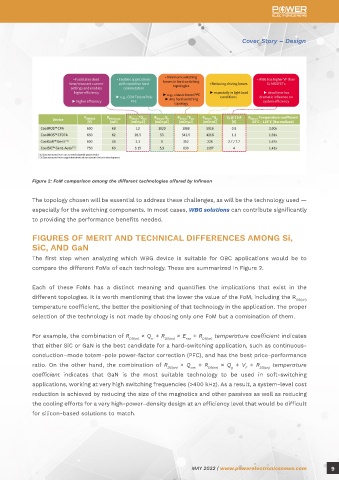
 house at peak times to reduce peak energy demands. However, to do so, the OBC needs to be   Figure 2: FoM comparison among the different technologies offered by Infineon
 able to transfer energy from the traction battery back to the grid instead of only charging the EV.
            The topology chosen will be essential to address these challenges, as will be the technology used —
 5.  Battery voltages are increasing. Even though the 400-V batteries will remain mainstream for the   especially for the switching components. In most cases, WBG solutions can contribute significantly
 next five-plus years, 800-V batteries are already getting more attractive. The main motivation is   to providing the performance benefits needed.
 primarily to reduce currents and the associated I R losses in cabling when charging and when
 2
 delivering energy to the traction motors.  FIGURES OF MERIT AND TECHNICAL DIFFERENCES AMONG Si,
            SiC, AND GaN

 Figure 1 looks at the most important trends with corresponding implications in the OBC design and   The first  step when  analyzing which WBG  device  is  suitable for  OBC  applications would  be to
 the key solution enablers for each.  compare the different FoMs of each technology. These are summarized in Figure 2.


            Each  of  these  FoMs  has  a  distinct  meaning  and  quantifies  the  implications  that  exist  in  the
            different topologies. It is worth mentioning that the lower the value of the FoM, including the R
                                                                                                         DS(on)
            temperature coefficient, the better the positioning of that technology in the application. The proper
            selection of the technology is not made by choosing only one FoM but a combination of them.


            For example, the combination of R      × Q  + R    × E  + R      temperature coefficient indicates
                                              DS(on)  rr   DS(on)  oss  DS(on)
            that either SiC or GaN is the best candidate for a hard-switching application, such as continuous-
            conduction–mode totem-pole power-factor correction (PFC), and has the best price-performance
            ratio. On the other hand, the combination of R      × Q  + R       × Q  + V  + R     temperature
                                                            DS(on)  oss   DS(on)  g    F    DS(on)
            coefficient indicates  that GaN is  the most suitable  technology  to be used in soft-switching
            applications, working at very high switching frequencies (>400 kHz). As a result, a system-level cost
            reduction is achieved by reducing the size of the magnetics and other passives as well as reducing

            the cooling efforts for a very high-power–density design at an efficiency level that would be difficult
            for silicon-based solutions to match.


 Figure 1: Trends in OBC design that represent several challenges to power designers


 8  MAY 2022 | www.powerelectronicsnews.com                         MAY 2022 | www.powerelectronicsnews.com          9

