


Page 6 - PEN eBook July 2022
P. 6
COVER STORY – DESIGN                                                                                                                                                                             Cover Story - Design


                                                                                                                                   other applications can be calculated. The goal of a filter circuit is to realize a defined insertion loss
                                                                                                                                   in the selected frequency range. This is achieved with a high impedance over the desired frequency
                                                                                                                                   range by the largest possible mismatch between load and source. Here, the insertion loss (a in

                                                                                                                                   Equation 1) is defined as the ratio of the voltage without filter compared with the same circuit with
                                                                                                                                   a filter. For a second-order LC filter, Equation 2 applies to the cutoff frequency (f ).
                                                                                                                                                                                                                   c

                                                                                                                                   Equation 1                                  Equation 2


                                                                                                                                   However, Equation 2 assumes ideal components. The inductance does not take into account the
                                                                                                                                   winding resistance or the capacitance between the windings, and for the capacitor the equivalent

                                                                                                                                   series resistance (ESR) and the equivalent series inductance (ESL), etc.

                                                                                                                                   REDEXPERT EMI FILTER DESIGNER
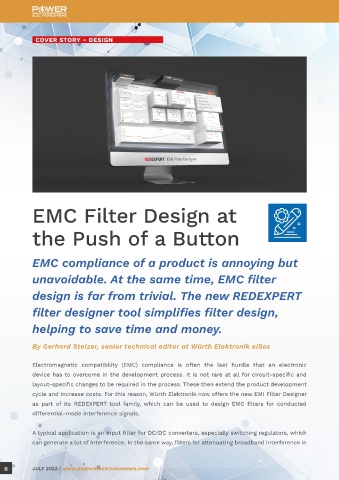
            EMC Filter Design at                                                                                                   REDEXPERT EMI Filter Designer takes these parasitic elements into account in the frequency range

                                                                                                                                   up to 30 MHz, so the simulation much more accurately reflects the real electrical behavior of the
            the Push of a Button                                                                                                   components and the filter characteristics up to fourth order.


                                                                                                                                   The EMI Filter Designer determines the most suitable topology as a suggestion from the input
            EMC compliance of a product is annoying but                                                                            variable’s operating voltage, current, load/line impedance stabilization network and interference
                                                                                                                                   source impedance, cutoff frequency, and attenuation at a defined frequency.
            unavoidable. At the same time, EMC filter


            design is far from trivial. The new REDEXPERT                                                                          A total  of  six topologies  are  available for filters from  second to fourth  order:  LC,  CL,  Pi  (CLC),
                                                                                                                                   T (LCL), LC-LC, and CL-CL.
            filter designer tool simplifies filter design,                                                                         After selecting the topology, the software calculates the discrete component values and simulates


            helping to save time and money.                                                                                        the frequency responses of gain, input impedance, and output impedance of the filter. A summary

                                                                                                                                   again  shows the  input values, the  circuit,  a  BOM with  an  ordering function,  and the  simulated
            By Gerhard Stelzer, senior technical editor at Würth Elektronik eiSos                                                  frequency  responses. The  calculation  and  the  following  automatic  selection  of  the  component
                                                                                                                                   values is based on a Butterworth characteristic with the corresponding position of the poles.
            Electromagnetic compatibility (EMC) compliance is often  the last hurdle  that an electronic
            device has to overcome in the development process. It is not rare at all for circuit-specific and                      PRACTICAL EXAMPLE WITH REDEXPERT EMI FILTER DESIGNER
            layout-specific changes to be required in the process. These then extend the product development                       REDEXPERT EMI Filter Designer is an online tool at www.we-online.com/filter-designer that is
            cycle and increase costs. For this reason, Würth Elektronik now offers the new EMI Filter Designer                     suitable for designing an input or output filter for AC/DC or DC/DC converters, etc. A typical input

            as  part  of  its  REDEXPERT  tool  family,  which  can  be  used  to  design  EMC  filters  for  conducted            filter for a DC/DC converter is shown in Figure 1. The main goal of the filter tool is to calculate a
            differential-mode interference signals.                                                                                clean signal attenuation for defined input parameters by achieving maximum impedance mismatch.


            A typical application is an input filter for DC/DC converters, especially switching regulators, which                  ASYMMETRICAL INPUT FILTER FOR DC/DC CONVERTERS
            can generate a lot of interference. In the same way, filters for attenuating broadband interference in                 A  good filter  design  requires the  most  accurate  input  specifications  possible.  In  reality,  DC/DC


   6        JULY 2022 | www.powerelectronicsnews.com                                                                                                                                       JULY 2022 | www.powerelectronicsnews.com         7

