


Page 27 - PEN eBook December 2022
P. 27
Power Supplies                                                                                    DESIGN


 due to derating required at low AC nominals. It was also limited in functionality and controllability,
 requiring inconvenient and expensive external hardware and modifications to the PSU. A better solution
 was the HPA1K5 from XP Power, a 1,500-W PSU based on a DSP platform that operates on single-phase

 80–264 VAC, with near-zero impact on output rating, for operation in any market. The digital control
 eliminated the external circuitry and PSU hardware modifications and added functionality including,
 critically, safe shutdown if the system enables signal fails. When proven by the user, through the
 supplied GUI, the settings were then factory-configured by XP Power before product shipment. The
 customer was able to leverage extra value from the PSU’s I C bus by interfacing to a credit-card–sized
 2
 single-board computer, which in turn provided a gateway to the user’s cloud network and enabled
 monitoring of the end-product power-rail performance globally, from a European control center. The
 user has a more competitive product with a component count, cost, and footprint reduced, with
 enhanced reliability a welcome bonus.


 Products like the HPA1K5 extend their applicability with worldwide ITE and medical (2 × MOPP) safety
 approvals and high power density. Nominal outputs can be configured as constant voltage, programmable
 0% to 105% of rated nominal, or as constant current 0% to 110% of the rated maximum. Features also
 include remote sense, current share for parallel units,
 a 5-V standby supply, and a temperature-controlled
            SiC MOSFET Reliability
 fan.


 Similar  products  in  the  “HP”  range  with  DSP
 functionality from XP Power include the HPL5K0 range,   Studies at Ohio State:
 rated at 5 kW with three-phase 180- to 264-VAC input,
 intended for higher-output-voltage applications, with   Short-Circuit Capability
 optional nominals of 60 V, 100 V, or 200 VDC. Another
 example is the HPT5K0, also rated at 5 kW but with
 a three-phase 180- to 528-VAC input, again with high   By Sonu Daryanani, contributing writer to Power Electronics News
 nominal output-voltage options and  two case-style

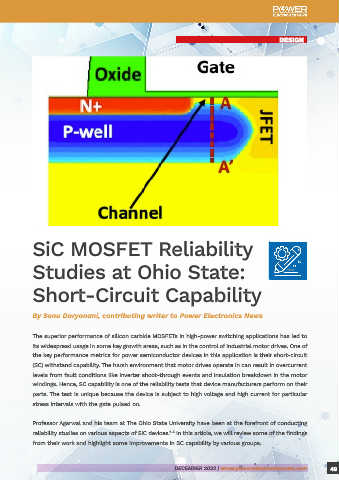
 variants.  Both  the  HPL  and  HPT  ranges  include  all   The superior performance of silicon carbide MOSFETs in high-power switching applications has led to
 of the digital control and monitoring described and   its widespread usage in some key growth areas, such as in the control of industrial motor drives. One of
 fast output slew rates, useful  for challenging  test   the key performance metrics for power semiconductor devices in this application is their short-circuit
 applications (Figure 3).  (SC) withstand capability. The harsh environment that motor drives operate in can result in overcurrent
            levels from fault conditions like inverter shoot-through events and insulation breakdown in the motor
 Figure 3: The HP range of products from XP and   CONCLUSION  windings. Hence, SC capability is one of the reliability tests that device manufacturers perform on their
 their programming GUI
 The era of “software-defined power” is finally with us,   parts. The test is unique because the device is subject to high voltage and high current for particular

 with AC/DC products available in which output voltage, current, and all functionality can be controlled   stress intervals with the gate pulsed on.
 and optimized simply by the user, then embedded in firmware for production, all without compromising
 cost and efficiency. Products can operate globally with certifications for a wide range of end applications   Professor Agarwal and his team at The Ohio State University have been at the forefront of conducting
 and be upgraded or reprogrammed for new ones with a simple connection to a laptop using software   reliability studies on various aspects of SiC devices.  In this article, we will review some of the findings
                                                            1–5
 and a GUI available from the manufacturer, putting the user now firmly in control.  from their work and highlight some improvements in SC capability by various groups.


 48  DECEMBER 2022 | www.powerelectronicsnews.com             DECEMBER 2022 | www.powerelectronicsnews.com           49

