


Page 29 - PEN eBook December 2022
P. 29
Design                                                                                      AUTOMOTIVE


   ▶   Bashar et al. (2021). “Comparison of Short Circuit Failure Modes in SiC Planar
 7
 MOSFETs, SiC Trench MOSFETs and SiC Cascode JFETs.” IEEE 8th Workshop

 on Wide Bandgap Power Devices and Applications (WiPDA).

   ▶   Nguyen et al. (2015). “Gate oxide reliability issues of SiC MOSFETs under
 8
 short-circuit operation.” IEEE Transactions on Power Electronics.

   ▶   Kim et al. (2021). “Improved Short-Circuit Ruggedness for 1.2kV 4H-SiC
 9
 MOSFET Using a Deep P-Well Implemented by Channeling Implantation.” IEEE

 Electron Device Letters.
            How Toyota Is
   ▶   Some details on Rohm’s fourth-generation trench SiC MOSFETs can be
 10
 found at www.rohm.com/products/sic-power-devices/sic-mosfet.
            Diversifying Its

   ▶   Hatta et al. (2017). “Suppression of Short-Circuit with Embedded Source
 11
 Resistance in SiC-MOSFET.” International Conference on Silicon Carbide and

 Related Materials.  Strategies for Next-Gen
            Vehicles


            By Maurizio Di Paolo Emilio, editor-in-chief of Power Electronics News


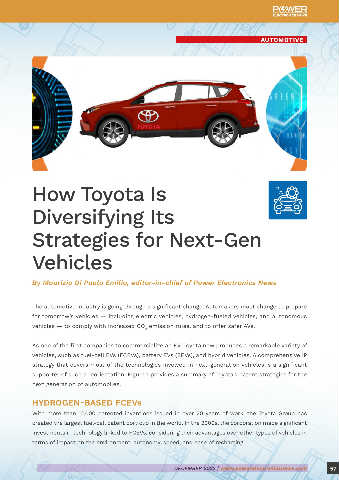
            The automotive industry is going through a significant change. Automakers must change to prepare
            for tomorrow’s vehicles — including electric vehicles, hydrogen-fueled vehicles, and autonomous
            vehicles — to comply with increased CO  emission rules, and to offer safer AVs.
                                                    2

            As one of the first companies to commercialize an EV, Toyota now produces a remarkable variety of
            vehicles, such as fuel-cell EVs (FCEVs), battery EVs (BEVs), and hybrid vehicles. A comprehensive IP
            strategy that covers most of the technologies involved in next-generation vehicles is a significant
            supporter of such a reorientation. Figure 1 provides a summary of Toyota’s patent strategies for the
            next generation of automobiles.


            HYDROGEN-BASED FCEVs

            With more than 12,000 patented inventions issued in over 20 years of work, the Toyota Group has
            created the largest fuel-cell patent portfolio in the world. In the 2000s, the corporation made significant
            investments in technology linked to FCEVs, considering their advantages over other types of vehicles in
            terms of impact on the environment, autonomy, speed, and ease of recharging.


 56  DECEMBER 2022 | www.powerelectronicsnews.com             DECEMBER 2022 | www.powerelectronicsnews.com           57

