


Page 55 - PEN Ebook March 2021
P. 55
SEMICONDUCTORS                                                                               Semiconductors


          SIC FETS ARE AN ALTERNATIVE                          slow edge rates for these types of fast switches,
          CHOICE                                               allowing perhaps the use of lower voltage devices

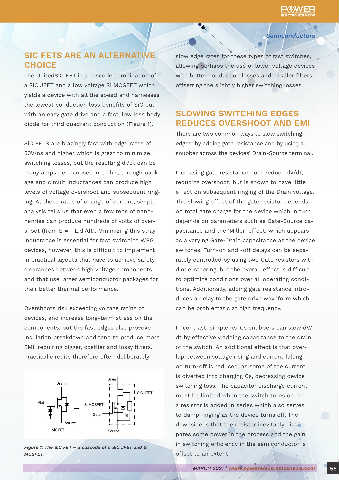
          The UnitedSiC FET is a cascode combination of        with better conduction losses and smaller filters,
          a SiC JFET and a low voltage Si MOSFET which         offsetting the slightly higher switching losses.
          yields a device with all the speed and harnesses
          the lowest conduction loss benefits of SiC but
          with an easy gate drive and a fast, low loss body    SLOWING SWITCHING EDGES
          diode for third quadrant conduction (Figure 1).      REDUCES OVERSHOOT AND EMI
                                                               There are two common ways to slow switching
          SiC FETS are blazingly fast with edge rates of       edges: by adding gate resistance and by using a

          50V/ns and higher which is great to minimize         snubber across the devices’ Drain-Source terminal.
          switching losses, but the resulting di/dt can be
          many amps per nanosecond. This, through pack-        Increasing gate resistance does reduce dV/dt,
          age and circuit inductances can produce high         reducing overshoot, but is shown to have little
          levels of voltage overshoot and subsequent ring-     effect on subsequent ringing of the Drain voltage.
          ing. At these rates of change of current, simple     The slowing effect of the gate resistor depends
          analysis tells us that even a few tens of nano-      on total gate charge for the device which in turn

          henries can produce hundreds of volts of over-       depends on parameters such as Gate-Source ca-
          shoot (from E = - L.di/dt). Minimizing this stray    pacitance and the ‘Miller’ effect, which appears
          inductance is essential for fast switching WBG       as a varying Gate-Drain capacitance as the device
          devices, however, this is difficult to implement     switches. Turn-on and -off delays can be sepa-
          in practical layouts that have to achieve safety     rately controlled by using two Gate resistors with
          clearances between high voltage components,          diode-steering, but the overall effect is difficult
          and that use larger semiconductor packages for       to optimize conditions over all operating condi-
          their better thermal performance.                    tions. Additionally, adding gate resistance intro-
                                                               duces a delay to the gate drive waveform which

          Overshoots risk exceeding voltage rating of          can be problematic at high frequency.
 Minimizing EMI and   devices, and increase long-term stress on the   In contrast, simple Rs-Cs snubbers can slow dV/

          components, but the fast edges also provoke
 switching loss in SiC   insulation breakdown and tend to produce more   dt by effectively adding capacitance to the drain

          EMI, requiring bigger, costlier and lossy filters.
                                                               of the switch. An additional effect is that over-
 FETs     Practical circuits therefore often deliberately      lap between voltage rising and current falling
                                                               on turn-off is reduced, as some of the current

                                                               is diverted into charging Cs, decreasing device
 By Peter Losee, Director of Technology Development, UnitedSiC  switching loss. The capacitor discharge current
                                                               must be limited when the switch turns on, so
                                                               a resistor is added in series which also serves
 In the new era of wide band-gap semiconductor   quite yet, with both device types having limita-  to damp ringing as the device turns off. The
 switches, the choice of device types includes SiC   tions in some areas, particularly in their particu-  downside is that the resistor inevitably dissi-
 MOSFETs and GaN HEMT cells, both with their   lar gate drive requirements and ‘third quadrant’   pates some power in the process and the gain
 own characteristics and claims to best perfor-  operation.    in switching efficiency in the semiconductor is
          Figure 1: The SiC FET – a cascode of a SiC JFET and Si
 mance. However, neither are the ideal switch   MOSFET.        offset to an extent.


 54  MARCH 2021 | www.powerelectronicsnews.com                       MARCH 2021 | www.powerelectronicsnews.com       55

