


Page 13 - Power Electronics News - December 2020
P. 13
Smart Energy                                                                                    Smart Energy


 One example is when Chris Henze was working   first in a long series of experiments aimed at opti-

 on his Ph. D at the University of Minnesota under   mizing digital control in power supplies, expanding
 the direction of Ned Mohan. Chris published some   the scope of opportunities for the DSP.
 interesting parts of his work at PESC in Toulouse in
 1985. In this work Chris was using a microprocessor   During the following years semiconductor man-
 and was switching at a reasonable frequency for a   ufacturers introduced many power controllers
 non-isolated dc-dc converter of that era.  with built in digital functionality with different
 architectures. Although there was some exist-
 In his paper he identified issues like quantization   ing I/O communication, the launch of the Power
 and the need to dither to get adequate PWM res-  Management Bus (PMBus), standardizing com-

 olution. The application presented by Chris Henze   mands to monitor and control a power controller
 is one among many that are representative of the   is considered by power designers a major step
 evolution from pure research to commercially   towards a new level of Smart Power.
 feasible applications based on microprocessors.
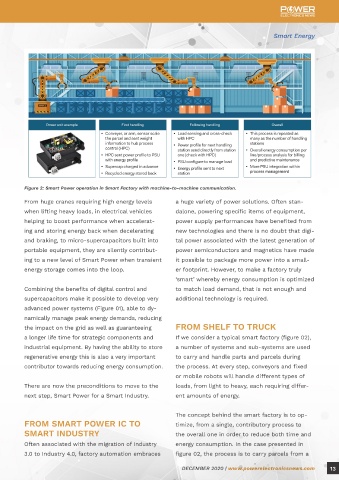
          Figure 2: Smart Power operation in Smart Factory with machine-to-machine communication.

 In the late 1990s TI contributed to develop the   SMART ENERGY STORAGE FOR A   From huge cranes requiring high energy levels   a huge variety of power solutions. Often stan-
 first fully digitally controlled UPS, based on the   SMART POWER  when lifting heavy loads, in electrical vehicles   dalone, powering specific items of equipment,

 digital signal processor C2000. Using a DSP to digi-  If digital power technology made it possible to   helping to boost performance when accelerat-  power supply performances have benefited from
 tally control the switching and power management   optimize power switching performance and to   ing and storing energy back when decelerating   new technologies and there is no doubt that digi-
 of a UPS system was the first practical application   control the power supply in every possible way,   and braking, to micro-supercapacitors built into   tal power associated with the latest generation of
 for digital power. This real-life application was the   the growing demand for intelligent power systems   portable equipment, they are silently contribut-  power semiconductors and magnetics have made
 integrated within demanding industries having   ing to a new level of Smart Power when transient   it possible to package more power into a small-
 complex loads e.g. repetitive peaks and regenera-  energy storage comes into the loop.  er footprint. However, to make a factory truly
 tive energy require ‘smart energy storage’.                   ‘smart’ whereby energy consumption is optimized
          Combining the benefits of digital control and        to match load demand, that is not enough and
 First commercially introduced by Nippon Electric   supercapacitors make it possible to develop very   additional technology is required.

 Corporation in 1978, Supercapacitor technolo-  advanced power systems (Figure 01), able to dy-
 gymade an impressive progress throughout the   namically manage peak energy demands, reducing
 following years, today benefiting from nanotech-  the impact on the grid as well as guaranteeing   FROM SHELF TO TRUCK
 nologies that make it possible to create huge   a longer life time for strategic components and   If we consider a typical smart factory (figure 02),
 capacity storage in smaller packages.  industrial equipment. By having the ability to store   a number of systems and sub-systems are used
 Figure 1: PRBX S-CAP BOOST supercapacitors bank with
 digital control and communication interface able to deliver   regenerative energy this is also a very important   to carry and handle parts and parcels during
 peak energy to load and to store backward energy.  contributor towards reducing energy consumption.  the process. At every step, conveyors and fixed
                                                               or mobile robots will handle different types of
          There are now the preconditions to move to the       loads, from light to heavy, each requiring differ-
          next step, Smart Power for a Smart Industry.         ent amounts of energy.


                                                               The concept behind the smart factory is to op-
          FROM SMART POWER IC TO                               timize, from a single, contributory process to
          SMART INDUSTRY                                       the overall one in order to reduce both time and
          Often associated with the migration of Industry      energy consumption. In the case presented in
          3.0 to Industry 4.0, factory automation embraces     figure 02, the process is to carry parcels from a


 12  DECEMBER 2020 | www.powerelectronicsnews.com                DECEMBER 2020 | www.powerelectronicsnews.com        13

