


Page 9 - Power Electronics News - December 2020
P. 9
Semiconductors                                                                               Semiconductors


                                                               ing established Si MOSFETs and IGBTs. This is

                                                               achieved with parts in standard discrete pack-
                                                               ages making them easy to engineer into new and
                                                               existing designs.


                                                               The excellent efficiency gains realized with Gen
                                                               3 SiC FETs from UnitedSiC promoted widespread
                                                               adoption of the technology and now Gen 4 is
                                                               delivering an entirely new level of performance,
                                                               enabled by advancing fabrication and packaging

                                                               technology.  With parts rated at 750V, designers
                                                               now have additional headroom over traditional
                                                               650V rated Si and SiC MOSFETs typically used in

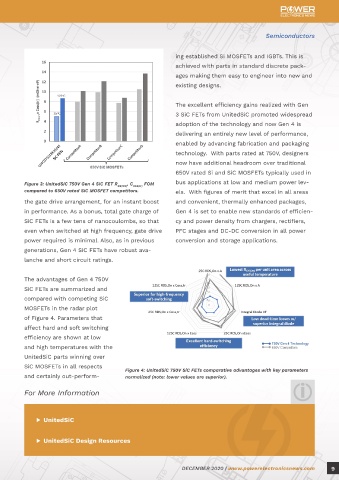
 Figure 1: UnitedSiC 750V Gen 4 SiC FET on-resistance per   Figure 2: UnitedSiC 750V Gen 4 SiC FET R DS(ON) , EOSS FOM   Figure 3: UnitedSiC 750V Gen 4 SiC FET R DS(ON) , C OSS(tr)  FOM   bus applications at low and medium power lev-
 unit area compared to 650V rated SiC MOSFET competitors.  compared to 650V rated SiC MOSFET competitors.  compared to 650V rated SiC MOSFET competitors.  els.  With figures of merit that excel in all areas
 ful comparison. The same UnitedSiC 18 milliohm   WBG device switching is to operate at higher   the gate drive arrangement, for an instant boost   and convenient, thermally enhanced packages,
 device as in Figure 1 is compared in Figure 2 with   frequencies to reduce size, cost and weight of   in performance. As a bonus, total gate charge of   Gen 4 is set to enable new standards of efficien-

 SiC MOSFET alternatives and the Gen 4 SiC FET   associated components, particularly magnetics,   SiC FETs is a few tens of nanocoulombs, so that   cy and power density from chargers, rectifiers,
 advantages are clear, 50% better FOM at 25°C and   the extra low C OSS(TR)  of Gen 4 SiC FETs is a dis-  even when switched at high frequency, gate drive   PFC stages and DC-DC conversion in all power
 40% at 125°C. In hard-switching applications such   tinct advantage.  power required is minimal. Also, as in previous   conversion and storage applications.
 as the ‘Totem-Pole PFC’ or in standard 2-level   generations, Gen 4 SiC FETs have robust ava-
 inverters, stored charge in the body diode is also   Gen 4 SiC FETs from UnitedSiC retain the ma-  lanche and short circuit ratings.
 important and is very low in SiC FETs, with just a   jor advantage that they can be safely driven
 small contribution from the integral low voltage Si   from fully off to saturation using a 0V-12V gate   The advantages of Gen 4 750V
 MOSFET. Although there is no parasitic body diode   drive with a maximum of +/20V, clamped by   SiC FETs are summarized and
 as such in the integrated JFET, there is a reverse   ESD protection diodes. The threshold voltage of   compared with competing SiC

 conduction path through the JFET channel and   5V allows unipolar operation. The device short   MOSFETs in the radar plot
 the body diode of the co-packaged Si MOSFET.   circuit current is controlled by the JFET channel,   of Figure 4. Parameters that
 The body diode drop appears as the sum of a 0.7V   which has a  largely temperature-independent   affect hard and soft switching
 knee voltage from the Silicon MOSFET, and the   threshold. Therefore, the short-circuit capabil-  efficiency are shown at low
 ohmic drop of the JFET channel, amounting to   ity becomes independent of gate drive voltage   and high temperatures with the
 1.3V or less. This compares with a typical 650V SiC   above 12V, a behavior quite unlike SiC MOSFET   UnitedSiC parts winning over
 MOSFET body diode which can drop more than 3V   and IGBTs. The Miller effect is effectively absent,   SiC MOSFETs in all respects
                                             Figure 4: UnitedSiC 750V SiC FETs comparative advantages with key parameters
 with hundreds of nanocoulombs of stored charge.  avoiding the possibility of spurious turn-on and   and certainly out-perform-  normalized (note: lower values are superior).
 packages offered include Kelvin connections to
 As shown in Figure 3, soft-switching applications   avoid source inductance being included in the   For More Information
 such as in LLC and PSFB converters also benefit   gate drive loop which might otherwise couple
 from using SiC FETs – while output capacitance   transients into the gate drive. As with earlier SiC     ▶ UnitedSiC
 C OSS(TR ) is not discharged rapidly in these circuits,   FET generations, the high maximum gate drive
 it does introduce a delay at the switch turn-off   voltage allows parts to be retrofitted into exist-
 edge as it charges, which can limit maximum   ing circuits to change out IGBTs, Si-MOSFETs and     ▶ UnitedSiC Design Resources
 useable frequency. As one of the attractions of   SiC-MOSFETs with little or no modification to


 8  DECEMBER 2020 | www.powerelectronicsnews.com                 DECEMBER 2020 | www.powerelectronicsnews.com        9

