


Page 32 - 23_EETE_03
P. 32
32 EE|Times EUROPE

        Green Electricity Key to Eliminating Transportation CO   2


           in heavily populated areas, and therefore, their operators are under   before a significant impact is felt. Regional airplanes and VTOLs
           particularly strong pressure to convert to zero-carbon fuel to miti-  will remain a small portion of airplane passenger miles traveled.
           gate pollution.                                       The solution is again increasing the use of low-carbon and
          •  Ships are categorized as either deep-sea or short-sea.  carbon-neutral fuel to power jet engines. Both biofuels and syn-
             Short-sea ships include ferries and coastal ships that make short   fuels will be used. These are often called sustainable aviation fuels.
           trips or trips with frequent stops. The short-sea ships have started   Here again, inexpensive and renewable electricity will generate
           converting to electric motors with batteries or fuel cells. Ferries   volume production of biofuels and synthetic fuels at competitive
           lead the conversion and are experiencing operational cost advan-  prices.
           tages from lower maintenance and less fuel expenditure. Ferries   •  Trains have come a long way from their coal-burning days and
           and coastal ships will move to electric motors in the next decade.   are already partly electrified. Many passenger trains today use
           However, this category accounts for a small portion of the overall   electric motors that get power from electricity along the rail tracks.
           fuel consumption of the maritime industry.            Currently, more than 55% of trains use electricity, though the exact
             Low-carbon and carbon-neutral fuels will be most important   percentage varies by region. Diesel locomotives also use electricity
           for large, deep-sea ships. This category includes tankers, bulk,   to propel trains. A diesel engine makes electricity via a generator
           container and other ships. Currently, these ships use marine gas oil,   that powers electric traction motors at the wheels. Diesel is used by
           which has higher CO 2  and other emissions than diesel-type fuels.   about 40% of trains. Biofuel is making some progress in train usage
           They often travel between countries and continents and have very   but will remain a niche market.
           large loads. The largest container ships can carry more than
           20,000 containers. Hence, ocean-going ships will stay with ICE   ELECTRICITY DRIVES TRANSPORTATION DECARBONIZATION
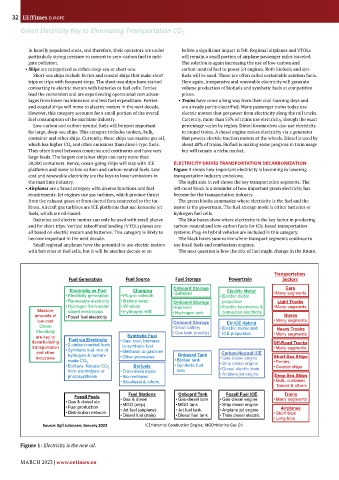
           platforms and move to low-carbon and carbon-neutral fuels. Low   Figure 1 shows how important electricity is becoming in lowering
           cost and renewable electricity are the keys to lower emissions in   transportation industry emissions.
           the maritime industry.                               The right side in red shows the key transportation segments. The
          •  Airplanes are a broad category with diverse functions and fuel   left-most block is a reminder of how important green electricity has
           requirements. Jet engines use gas turbines, which produce thrust   become for the transportation industry.
           from the exhaust gases or from ducted fans connected to the tur-  The green blocks summarize where electricity is the fuel and the
           bines. Aircraft gas turbines are ICE platforms that use kerosene jet   motor is the powertrain. The fuel storage mode is either batteries or
           fuels, which are oil-based.                        hydrogen fuel cells.
             Batteries and electric motors can only be used with small planes   The blue boxes show where electricity is the key factor in producing
           and for short trips. Vertical takeoff and landing (VTOL) planes are   carbon-neutral and low-carbon fuels for ICE-based transportation
           all based on electric motors and batteries. This category is likely to   systems. Plug-in hybrid vehicles are included in this category.
           become important in the next decade.                 The black boxes summarize where transport segments continue to
             Small regional airplanes have the potential to use electric motors   use fossil fuels and combustion engines.
           with batteries or fuel cells, but it will be another decade or so   The next question is how the mix of fuel might change in the future.


                                                                                                 Transportation
                         Fuel Generation     Fuel Source       Fuel Storage      Powertrain         Sectors
                                                                                                     Cars
                         Electricity as Fuel    Charging      Onboard Storage    Electric Motor  • Many segments
                        • Electricity generation:  • Plug-in network  • Batteries  • Electric motor
                        • Renewable electricity  • Battery swap  Onboard Storage  propulsion      Light Trucks
                        • Hydrogen from water-  • Wireless    • Fuel-cell     • Electric locomotive &  • Many segments
              Massive    based electrolysis  • Hydrogen refill  • Hydrogen tank  connected electricity
             amounts of   • Fossil fuel electricity                                                  Buses
              low-cost                                        Onboard Storage    EV-ICE Hybrid   • Many segments
               Green                                          • Small battery  • Electric motor and  Heavy Trucks
              Electricity                                     • Gas tank (mostly)  ICE propulsion  • Many segments
              are key to                      Synthetic Fuel
                         Fuel via Electricity
            decarbonizing   • 2 carbon-neutral fuels  • Gas, coal, biomass                       Off-Road Trucks
            transportation   • Synthetic fuel: mix of  to synthetic fuel                         • Many segments
              and other                    • Methanol to gasoline  Onboard Tank  Carbon-Neutral ICE
              industries  hydrogen & human-  • Other processes  • Biofuel tank  • Gas-diesel engine  Short-Sea Ships
                         made CO 2                                            • Ship diesel engine  • Ferries
                        • Biofuels: Natural CO 2  Biofuels    • Synthetic fuel  • Diesel electric train  • Coastal ships
                         from electrolysis or  • From electrolysis  tank      • Airplane jet engine
                         photosynthesis    • Bio-methanol                                        Deep-Sea Ships
                                           • Bio-diesel & others                                 • Bulk, container,
                                                                                                  Tanker & others
                                                                                                     Trains
                           Fossil Fuels       Fuel Stations     Onboard Tank    Fossil Fuel ICE  • Many segments
                        • Gas & diesel etc.  • Gas & diesel    • Gas-diesel tank  • Gas-diesel engine
                        • Fuel production  • MGO (ship)        • MGO tank     • Ship diesel engine  Airplanes
                                                               • Jet fuel tank
                                                                              • Airplane jet engine
                                           • Jet fuel (airplane)
                        • Distribution network                                                   • Short trips
                                           • Diesel fuel (train)  • Diesel fuel tank  • Train diesel electric
                                                                                                 • Long trips
                Source: Egil Juliussen; January 2023  ICE=Internal Combustion Engine; MGO=Marine Gas Oil
        Figure 1: Electricity is the new oil.

        MARCH 2023 | www.eetimes.eu

