


Page 31 - 23_EETE_03
P. 31
EE|Times EUROPE   31

                                                       Green Electricity Key to Eliminating Transportation CO   2


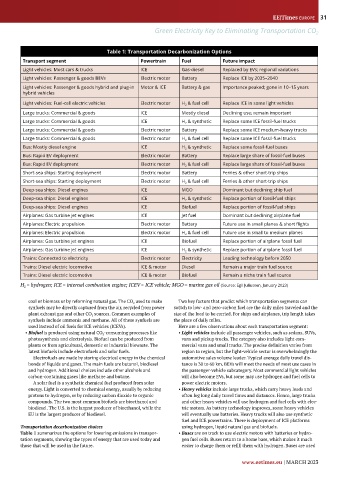
                                       Table 1: Transportation Decarbonization Options

         Transport segment                        Powertrain     Fuel          Future impact
         Light vehicles: Most cars & trucks       ICE            Gas-diesel    Replaced by EVs; regional variations
         Light vehicles: Passenger & goods BEVs   Electric motor  Battery      Replace ICE by 2035–2040
         Light vehicles: Passenger & goods hybrid and plug-in   Motor & ICE   Battery & gas   Importance peaked; gone in 10–15 years
         hybrid vehicles
         Light vehicles: Fuel-cell electric vehicles  Electric motor  H 2  & fuel cell  Replace ICE in some light vehicles
         Large trucks: Commercial & goods         ICE            Mostly diesel  Declining use; remain important
         Large trucks: Commercial & goods         ICE            H 2  & synthetic  Replace some ICE fossil-fuel trucks
         Large trucks: Commercial & goods         Electric motor  Battery      Replace some ICE medium-heavy trucks
         Large trucks: Commercial & goods         Electric motor  H 2  & fuel cell  Replace some ICE fossil-fuel trucks
         Bus: Mostly diesel engine                ICE            H 2  & synthetic  Replace some fossil-fuel buses
         Bus: Rapid EV deployment                 Electric motor  Battery      Replace large share of fossil-fuel buses
         Bus: Rapid EV deployment                 Electric motor  H 2  & fuel cell  Replace large share of fossil-fuel buses
         Short-sea ships: Starting deployment     Electric motor  Battery      Ferries & other short-trip ships
         Short-sea ships: Starting deployment     Electric motor  H 2  & fuel cell  Ferries & other short-trip ships
         Deep-sea ships: Diesel engines           ICE            MGO           Dominant but declining ship fuel
         Deep-sea ships: Diesel engines           ICE            H 2  & synthetic  Replace portion of fossil-fuel ships
         Deep-sea ships: Diesel engines           ICE            Biofuel       Replace portion of fossil-fuel ships
         Airplanes: Gas turbine jet engines       ICE            Jet fuel      Dominant but declining airplane fuel
         Airplanes: Electric propulsion           Electric motor  Battery      Future use in small planes & short flights
         Airplanes: Electric propulsion           Electric motor  H 2  & fuel cell  Future use in small to medium planes
         Airplanes: Gas turbine jet engines       ICE            Biofuel       Replace portion of airplane fossil fuel
         Airplanes: Gas turbine jet engines       ICE            H 2  & synthetic  Replace portion of airplane fossil fuel
         Trains: Connected to electricity         Electric motor  Electricity  Leading technology before 2050
         Trains: Diesel electric locomotive       ICE & motor    Diesel        Remain a major train fuel source
         Trains: Diesel electric locomotive       ICE & motor    Biofuel       Remain a niche train fuel source
        H 2  = hydrogen; ICE = internal combustion engine; ICEV = ICE vehicle; MGO = marine gas oil (Source: Egil Juliussen, January 2023)

           coal or biomass or by reforming natural gas. The CO 2  used to make   Two key factors that predict which transportation segments can
           synfuels may be directly captured from the air, recycled from power   switch to low- and zero-carbon fuel are the daily miles traveled and the
           plant exhaust gas and other CO 2  sources. Common examples of   size of the load to be carried. For ships and airplanes, trip length takes
           synfuels include ammonia and methane. All of these synfuels are   the place of daily miles.
           used instead of oil fuels for ICE vehicles (ICEVs).  Here are a few observations about each transportation segment:
          •   Biofuel is produced using natural CO 2 -consuming processes like   •   Light vehicles include all passenger vehicles, such as sedans, SUVs,
           photosynthesis and electrolysis. Biofuel can be produced from   vans and pickup trucks. The category also includes light com-
           plants or from agricultural, domestic or industrial biowaste. The   mercial vans and small trucks. The precise definition varies from
           latest biofuels include electrofuels and solar fuels.  region to region, but the light-vehicle sector is overwhelmingly the
             Electrofuels are made by storing electrical energy in the chemical   automotive sales volume leader. Typical average daily travel dis-
           bonds of liquids and gases. The main fuels are butanol, biodiesel   tance is 30 to 60 km. BEVs will meet the needs of most use cases in
           and hydrogen. Additional choices include other alcohols and    the passenger-vehicle subcategory. Most commercial light vehicles
           carbon-containing gases like methane and butane.      will also become EVs, but some may use hydrogen and fuel cells to
             A solar fuel is a synthetic chemical fuel produced from solar   power electric motors.
           energy. Light is converted to chemical energy, usually by reducing   •  Heavy vehicles include large trucks, which carry heavy loads and
           protons to hydrogen, or by reducing carbon dioxide to organic   often log long daily travel times and distances. Hence, large trucks
           compounds. The two most common biofuels are bioethanol and   and other heavy vehicles will use hydrogen and fuel cells with elec-
           biodiesel. The U.S. is the largest producer of bioethanol, while the   tric motors. As battery technology improves, some heavy vehicles
           EU is the largest producer of biodiesel.              will eventually use batteries. Heavy trucks will also use synthetic
                                                                 fuel and ICE powertrains. There is deployment of ICE platforms
        Transportation decarbonization choices                   using hydrogen, liquid natural gas and biofuels.
        Table 1 summarizes the options for lowering emissions in transpor-  •   Buses are on track to use electric motors with batteries or hydro-
        tation segments, showing the types of energy that are used today and   gen fuel cells. Buses return to a home base, which makes it much
        those that will be used in the future.                   easier to charge them or refill them with hydrogen. Buses are used

                                                                                      www.eetimes.eu | MARCH 2023

