


Page 29 - 23_EETE_03
P. 29
EE|Times EUROPE   29

                                                                    Can We Trust AI in Safety-Critical Systems?


        standard that accepts proof by example,”
        he said. “There’s a section that says you can
        prove not by design but by testing—or by
        real-life usage—so if you can show in real life
        that there is a certain level of non-failure, you
        can say that this works. … The only problem
        is that this is not transferrable, so for the next
        system, you would have to prove it again.”
          In practice, the amount of test data
        required without the ability to bring certified
        subsystems to new designs may mean this
        route to certification is not economical, he
        added.

        SAFETY CONCEPTS
        General safety concepts like redundancy are
        not mutually exclusive with AI, according to
        Ryan Zhao, general manager for motor drives
        and robotics at TI. “We can do some redun-
        dancy in the design,” he said. “We can use
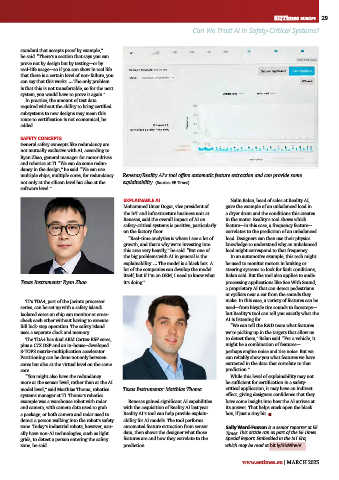
        multiple chips, multiple cores, for redundancy   Renesas/Reality AI’s tool offers automatic feature extraction and can provide some
        not only at the silicon level but also at the   explainability. (Source: EE Times)
        software level.”
                                            EXPLAINABLE AI                        Nalin Balan, head of sales at Reality AI,
                                            Mohammed Umar Dogar, vice president of   gave the example of an unbalanced load in
                                            the IoT and infrastructure business unit at   a dryer drum and the conditions this creates
                                            Renesas, said the overall impact of AI on   in the motor. Reality’s tool shows which
                                            safety-critical systems is positive, particularly   feature—in this case, a frequency feature—
                                            on the factory floor.               correlates to the prediction of an unbalanced
                                              “Real-time analytics is where I see a lot of   load. Designers can then use their physics
                                            growth, and that’s why we’re investing into   knowledge to understand why an unbalanced
                                            this area very heavily,” he said. “But one of   load might correspond to that frequency.
                                            the big problems with AI in general is the   In an automotive example, this tech might
                                            explainability. … The model is a black box. A   be used to monitor motors in braking or
                                            lot of the companies can develop the model   steering systems to look for fault conditions,
                                            itself, but if I’m an OEM, I need to know what   Balan said. But the tool also applies to audio
        Texas Instruments’ Ryan Zhao        it’s doing.”                        processing applications like See With Sound,
                                                                                a proprietary AI that can detect pedestrians
                                                                                or cyclists near a car from the sounds they
          TI’s TDA4, part of the Jacinto processor                              make. In this case, a variety of features can be
        series, can be set up with a safety island:                             used—from bicycle tire sounds to footsteps—
        Isolated cores on chip can monitor or cross-                            but Reality’s tool can tell you exactly what the
        check each other without having to execute                              AI is listening for.
        full lock-step operation. The safety island                               “We can tell the R&D team what features
        uses a separate clock and memory.                                       we’re picking up in the targets that allow us
          The TDA4 has dual ARM Cortex-R5F cores,                               to detect them,” Balan said. “For a vehicle, it
        plus a C7X DSP and an in-house–developed                                might be a combination of features—
        8-TOPS matrix-multiplication accelerator.                               perhaps engine noise and tire noise. But we
        Partitioning can be done not only between                               can reliably show you what features we have
        cores but also at the virtual level on the same                         extracted in the data that correlate to that
        core.                                                                   prediction.”
          “You might also have the redundancy                                     While this level of explainability may not
        more at the sensor level, rather than at the AI                         be sufficient for certification in a safety-
        model level,” said Matthias Thoma, robotics   Texas Instruments’ Matthias Thoma  critical application, it may have an indirect
        systems manager at TI. Thoma’s robotics                                 effect, giving designers confidence that they
        example was a warehouse robot with radar   Renesas gained significant AI capabilities   have some insight into how the AI arrives at
        and camera, with camera data used to grab   with the acquisition of Reality AI last year.   its answer. That helps crack open the black
        a package, or both camera and radar used to   Reality AI’s tool can help provide explain-  box, if just a tiny bit. ■
        detect a person walking into the robot’s safety   ability for AI models. The tool performs
        zone. Today’s industrial robots, however, usu-  automated feature extraction from sensor   Sally Ward-Foxton is a senior reporter at EE
        ally have non-AI technologies, such as light   data, then shows the designer what those   Times. This article ran as part of the EE Times
        grids, to detect a person entering the safety   features are and how they correlate to the   Special Report: Embedded in the IoT Era,
        zone, he said.                      prediction.                         which may be read at bit.ly/3lxWhwV.

                                                                                      www.eetimes.eu | MARCH 2023

