


Page 18 - 23_EETE_03
P. 18
18 EE|Times EUROPE

        Hardware-Based Design Approach for Smart-Home IoT Security


                                                                                and originality before installation, decrypting
                                                                                the new firmware and checking for the version
                                                                                of the update.
                                                                                  Cryptography is also critical in ensuring
                                                                                data or code confidentiality, integrity and
                                                                                authentication. ST uses two types of embed-
                                                                                ded cryptographic accelerators on the STM32
                                                                                microcontroller board. The random-number
                                                                                generator creates session keys for secured
                                                                                communication but can add latency, which
                                                                                can have consequences in mission-critical
                                                                                applications. To prevent delays during data
                                                                                encryption and decryption, the STM32 MCUs
                                                                                also come with cryptographic accelerators,
                                                                                which ensure faster hashing and running of
                                                                                symmetric algorithms.
                                                                                  “Hence, two accelerators are present
                                                                                onboard—one to protect the master keys and
                                                                                one to facilitate faster key exchange,” Crespo
                                                                                said.
                                                                                  STM32Trust is compatible with firmware
                                                                                in applications ranging from industries to
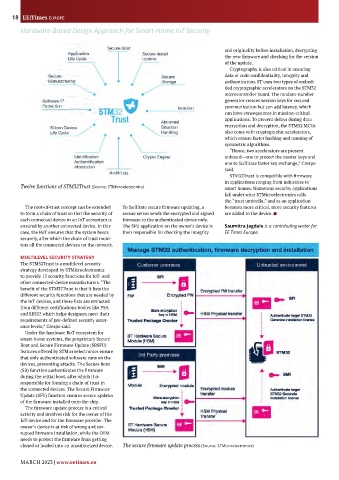
        Twelve functions of STM32Trust (Source: STMicroelectronics)             smart homes. Numerous security applications
                                                                                fall under what STMicroelectronics calls
                                                                                the “trust umbrella,” and as an application
          The root-of-trust concept can be extended   To facilitate secure firmware updating, a   becomes more critical, more security features
        to form a chain of trust so that the security of   secure server sends the encrypted and signed   are added to the device. ■
        each connected device in an IoT ecosystem is   firmware to the authenticated device only.
        ensured by another connected device. In this   The SFU application on the owner’s device is   Saumitra Jagdale is a contributing writer for
        case, the RoT ensures that the system boots   then responsible for checking the integrity   EE Times Europe.
        securely, after which the chain of trust moni-
        tors all the connected devices on the network.

        MULTILEVEL SECURITY STRATEGY
        The STM32Trust is a multilevel security
        strategy developed by STMicroelectronics
        to provide 12 security functions for IoT- and
        other connected-device manufacturers. “The
        benefit of the STM32Trust is that it lists the
        different security functions that are needed by
        the IoT devices, and these lists are extracted
        from different certifications bodies like PSA
        and SESIP, which helps designers meet their
        requirements of pre-defined security assur-
        ance levels,” Crespo said.
          Under the hardware RoT ecosystem for
        smart-home systems, the proprietary Secure
        Boot and Secure Firmware Update (SBSFU)
        features offered by STMicroelectronics ensure
        that only authenticated software runs on the
        devices, preventing attacks. The Secure Boot
        (SB) function authenticates the firmware
        during the initial boot, after which it is
        responsible for forming a chain of trust in
        the connected devices. The Secure Firmware
        Update (SFU) function ensures secure updates
        of the firmware installed onto the chip.
          The firmware update process is a critical
        activity and involves risk for the owner of the
        IoT device and for the firmware provider. The
        owner’s device is at risk of wrong and cor-
        rupted firmware installation, while the OEM
        needs to protect the firmware from getting
        cloned or loaded into an unauthorized device.   The secure firmware update process (Source: STMicroelectronics)

        MARCH 2023 | www.eetimes.eu

