


Page 20 - 23_EETE_03
P. 20
20 EE|Times EUROPE


         EMBEDDED WORLD 2023: SECURITY FOCUS
        Hardware Root of Trust: The Key to IoT Security


        in Smart Homes


        By Anne-Françoise Pelé

                  hen everything is connected,   secure. Intrinsic ID, a spinout of Royal Philips
                  everything is at risk. The   Electronics, has developed IP solutions based
                  proliferation of internet-of-  on physical unclonable functions (PUFs) to
        Wthings devices for smart homes     secure connected devices.
        has raised security and privacy concerns for
        their users. By implementing a hardware   SECURING TRUST
        root of trust, the authenticity, integrity and   With the explosion of connected IoT devices
        confidentiality of devices are enforced, and   per household, it has become critical to
        smart homes are protected against would-be   ensure data security and privacy preservation.
        attackers.                          Every device potentially represents an entry
                                            point for malicious intrusion, from the device
        Implementing a hardware             itself to the network it is connected to.
                                              A hardware root of trust is the foundation
        root of trust enforces the          for protecting smart-home endpoints and
        authenticity, integrity and         services. It establishes an anchor point for the
                                            chain of trust by creating a unique, immutable
        confidentiality of devices and      and unclonable identity to authorize a device   Intrinsic ID’s Pim Tuyls

        protects smart homes from           in the IoT network.
                                              For many years, PUFs have been deployed
        would-be attackers.                 as a hardware root of trust. A PUF is a physical   and scalable way, we extract the credentials
                                            structure from which a device-unique and
                                            unclonable cryptographic key is created. It   from the hardware of the chip itself,” Pim
          Security in IoT should never be an after-  leverages the deep-submicron variations that   Tuyls, CEO of Intrinsic ID, explained in an
        thought. Over the years, attacks have become   occur naturally during the chip-   interview with EE Times Europe. “Every chip
        more frequent, sophisticated, devious and   manufacturing process and gives each transis-  is physically different due to the process by
        targeted. From the voice assistant to the baby   tor slightly random electrical properties.  which it is made.
        monitor to the smart-heating system, billions   There are different ways to use a PUF to   “When a chip is made, silicon is doped to
        of smart-home devices are now vulnerable to   secure a device. Eindhoven, Netherlands–  make sure you get some electrical properties
        endpoint intrusions.                based Intrinsic ID has built a foundation of   in the transistors,” he added. “That doping
          To establish a foundation of trust, IoT   trust based on static random-access memory   cannot be 100% controlled, and the result is
        device makers need to get identities and   (SRAM) PUFs.                 that every transistor on the chip has a unique
        keys into their devices and keep these assets   “To build a root of trust in a very secure   threshold voltage.”


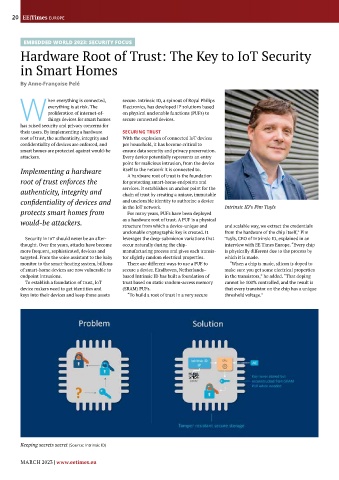
        Keeping secrets secret (Source: Intrinsic ID)

        MARCH 2023 | www.eetimes.eu

