


Page 23 - 23_EETE_03
P. 23
EE|Times EUROPE   23


         EMBEDDED WORLD 2023: ANALOG DESIGN
        Design Challenges Shift for Embedded Analog


        Systems


        By Majeed Ahmad


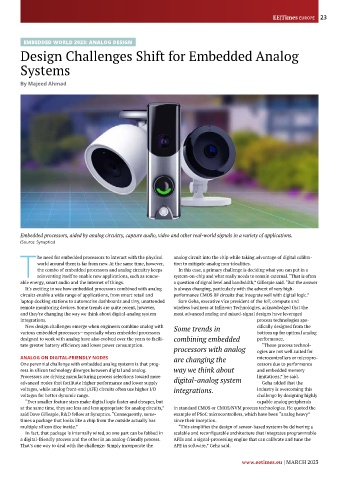
        Embedded processors, aided by analog circuitry, capture audio, video and other real-world signals in a variety of applications.
        (Source: Synaptics)


              he need for embedded processors to interact with the physical   analog circuit into the chip while taking advantage of digital calibra-
              world around them is far from new. At the same time, however,   tion to mitigate analog non-idealities.
              the combo of embedded processors and analog circuitry keeps   In this case, a primary challenge is deciding what you can put in a
        T reinventing itself to enable new applications, such as renew-  system-on-chip and what really needs to remain external. “That is often
        able energy, smart audio and the internet of things.   a question of signal level and bandwidth,” Gillespie said. “But the answer
          It’s exciting to see how embedded processors combined with analog   is always changing, particularly with the advent of very high-
        circuits enable a wide range of applications, from smart retail and   performance CMOS RF circuits that integrate well with digital logic.”
        laptop docking stations to automotive dashboards and tiny, unattended   Sam Geha, executive vice president of the IoT, compute and
        remote monitoring devices. Some trends are quite recent, however,   wireless business at Infineon Technologies, acknowledged that the
        and they’re changing the way we think about digital-analog system   most advanced analog and mixed-signal designs have leveraged
        integrations.                                                                      process technologies spe-
          New design challenges emerge when engineers combine analog with   Some trends in   cifically designed from the
        various embedded processors—especially when embedded processors                    bottom up for optimal analog
        designed to work with analog have also evolved over the years to facili-  combining embedded   performance.
        tate greater battery efficiency and lower power consumption.                         “Those process technol-
                                                              processors with analog       ogies are not well suited for
        ANALOG ON DIGITAL-FRIENDLY NODES                      are changing the             microcontrollers or micropro-
        One perennial challenge with embedded analog systems is that prog-                 cessors due to performance
        ress in silicon technology diverges between digital and analog.   way we think about   and embedded memory
        Processors are driving manufacturing process selections toward more   digital-analog system   limitations,” he said.
        advanced nodes that facilitate higher performance and lower supply                   Geha added that the
        voltages, while analog front-end (AFE) circuits often use higher I/O   integrations.  industry is overcoming this
        voltages for better dynamic range.                                                 challenge by designing highly
          “Ever smaller feature sizes make digital logic faster and cheaper, but           capable analog peripherals
        at the same time, they are less and less appropriate for analog circuits,”   in standard CMOS or CMOS/NVM process technologies. He quoted the
        said Dave Gillespie, R&D fellow at Synaptics. “Consequently, some-  example of PSoC microcontrollers, which have been “analog heavy”
        times a package that looks like a chip from the outside actually has   since their inception.
        multiple silicon dice inside.”                          “This simplifies the design of sensor-based systems by delivering a
          In fact, that package is internally wired, so one part can be fabbed in   scalable and reconfigurable architecture that integrates programmable
        a digital-friendly process and the other in an analog-friendly process.   AFEs and a signal-processing engine that can calibrate and tune the
        That’s one way to deal with the challenge: Simply incorporate the    AFE in software,” Geha said.

                                                                                      www.eetimes.eu | MARCH 2023

