


Page 16 - 23_EETE_03
P. 16
16 EE|Times EUROPE

        IoT Security: What’s Driving the Software-to-Hardware Shift?


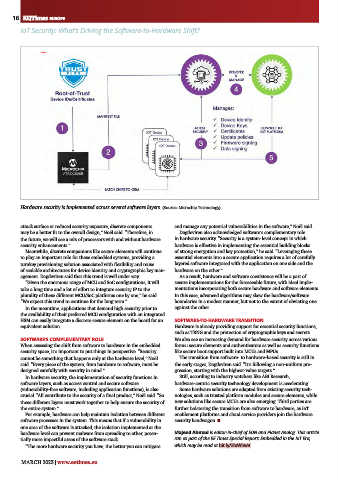
        Hardware security is implemented across several software layers. (Source: Microchip Technology)


        attack surface or reduced security exposure, discrete components   and manage any potential vulnerabilities in the software,” Noël said.
        may be a better fit to the overall design,” Noël said. “Therefore, in   Dagdeviren also acknowledged software’s complementary role
        the future, we will see a mix of processors with and without hardware   in hardware security. “Security is a system-level concept in which
        security enhancements.”                               hardware is effective in implementing the essential building blocks
          Meanwhile, discrete companions like secure elements will continue   of strong encryption and key protection,” he said. “Leveraging these
        to play an important role for these embedded systems, providing a   essential elements into a secure application requires a lot of carefully
        turnkey provisioning solution associated with flexibility and reuse   layered software integrated with the application on one side and the
        of scalable architectures for device identity and cryptographic key man-  hardware on the other.”
        agement. Dagdeviren said that this trend is well under way.  As a result, hardware and software coexistence will be a part of
          “Given the enormous range of MCU and SoC configurations, it will   secure implementations for the foreseeable future, with ideal imple-
        take a long time and a lot of effort to integrate security IP to the    mentations incorporating both secure hardware and software elements.
        plurality of these different MCU/SoC platforms one by one,” he said.   In this case, advanced algorithms may skew the hardware/software
        “We expect this trend to continue for the long term.”  boundaries in a modest manner, but not to the extent of obviating one
          In the meantime, applications that demand high security prior to   against the other.
        the availability of their preferred MCU configuration with an integrated
        HSM can easily integrate a discrete secure element on the board for an   SOFTWARE-TO-HARDWARE TRANSITION
        equivalent solution.                                  Hardware is already providing support for essential security functions,
                                                              such as TRNG and the protection of cryptographic keys and secrets.
        SOFTWARE’S COMPLEMENTARY ROLE                         We also see an increasing demand for hardware security across various
        When assessing the shift from software to hardware in the embedded   forms: secure elements and authenticators as well as security functions
        security space, it’s important to put things in perspective. “Security   like secure boot support built into MCUs and MPUs.
        cannot be something that happens only at the hardware level,” Noël   The transition from software- to hardware-based security is still in
        said. “Every piece of the system, from hardware to software, must be   the early stages, Dagdeviren said. “It’s following a non-uniform pro-
        designed carefully with security in mind.”            gression, starting with the highest-value targets.”
          In hardware security, the implementation of security functions in   Still, according to industry watchers like ABI Research,
        software layers, such as access control and secure software    hardware-centric security technology development is accelerating.
        (vulnerability-free software, including application functions), is also   Some hardware solutions are adapted from existing security tech-
        crucial. “All contribute to the security of a final product,” Noël said. “So   nologies, such as trusted platform modules and secure elements, while
        these different layers must work together to help ensure the security of   new solutions like secure MCUs are also emerging. Third parties are
        the entire system.”                                   further bolstering the transition from software to hardware, as IoT
          For example, hardware can help maintain isolation between different   enablement platforms and cloud service providers join the hardware
        software processes in the system. This means that if a vulnerability in   security bandwagon. ■
        one area of the software is attacked, the isolation implemented at the
        hardware level can prevent malware from spreading to other, poten-  Majeed Ahmad is editor-in-chief of EDN and Planet Analog. This article
        tially more impactful areas of the software stack.    ran as part of the EE Times Special Report: Embedded in the IoT Era,
          “The more hardware security you have, the better you can mitigate   which may be read at bit.ly/3lxWhwV.

        MARCH 2023 | www.eetimes.eu

