


Page 35 - EE Times Europe March 2022
P. 35
EE|Times EUROPE   35

                                                 Wide-Bandgap Semiconductors: The Next Wave of GaN and SiC


           2.6-gigaton-per-year reduction by 2050.”  in favor of devices that have integrated   power density, it is allowing us to have
             GaN power device manufacturers agree   functions on board, said Lidow. “For GaN, it’s   lower system cost.
           that the move from discrete GaN to higher   about integration going forward.”  “We’re about 50% higher in power den-
           integration will drive increased efficiency.                            sities — so again, smaller, lighter, cooler
           Both Navitas and EPC discussed their   SiC: ADVANCES AND SAVINGS        — and we’re able to show about a net system
           integrated GaN products, which deliver on   The benefits of SiC power devices are higher   cost benefit of 18%,” he added.
           improved efficiency, smaller size, and greater   efficiency and higher switching frequen-  For UnitedSiC, a big part of its strategy
           power output.                       cies. Those features translate into smaller   is delivering low R DS(on) . Losee devoted a
             One example is Navitas’s GaNFast power   system devices, higher power density, and   portion of his discussion to the company’s
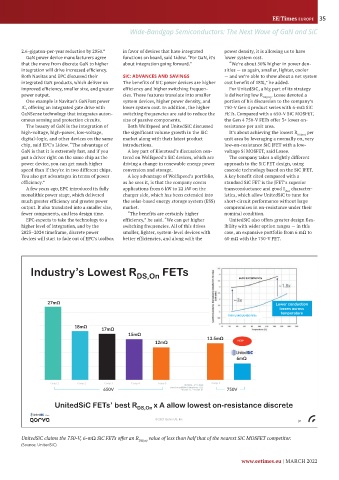
           IC, offering an integrated gate drive with    lower system cost. In addition, the higher   750-V Gen 4 product series with 6-mΩ SiC
           GaNSense technology that integrates auton-  switching frequencies are said to reduce the   FETs. Compared with a 650-V SiC MOSFET,
           omous sensing and protection circuits.  size of passive components.     the Gen 4 750-V FETs offer 3× lower on-
             The beauty of GaN is the integration of   Both Wolfspeed and UnitedSiC discussed   resistance per unit area.
           high-voltage, high-power, low-voltage,    the significant volume growth in the SiC   It’s about achieving the lowest R DS(on)  per
           digital-logic, and other devices on the same   market along with their latest product   unit area by leveraging a normally on, very
           chip, said EPC’s Lidow. “The advantage of   introductions.              low-on-resistance SiC JFET with a low-
           GaN is that it is extremely fast, and if you   A key part of Kierstead’s discussion cen-  voltage Si MOSFET, said Losee.
           put a driver right on the same chip as the   tered on Wolfspeed’s SiC devices, which are   The company takes a slightly different
           power device, you can get much higher   driving a change in renewable energy power   approach to the SiC FET design, using
           speed than if they’re in two different chips.   conversion and storage.  cascode technology based on the SiC JFET.
           You also get advantages in terms of power   A key advantage of Wolfspeed’s portfolio,   A key benefit cited compared with a
           efficiency.”                        as he sees it, is that the company covers   standard SiC FET is the JFET’s superior
             A few years ago, EPC introduced its fully   applications from 6 kW to 22 kW on the   transconductance and good I dsat  character-
           monolithic power stage, which delivered   charger side, which has been extended into   istics, which allow UnitedSiC to tune for
           much greater efficiency and greater power   the solar-based energy storage system (ESS)   short-circuit performance without large
           output. It also translated into a smaller size,   market.               compromises in on-resistance under their
           fewer components, and less design time.  “The benefits are certainly higher   nominal condition.
             EPC expects to take the technology to a   efficiency,” he said. “We can get higher   UnitedSiC also offers greater design flex-
           higher level of integration, and by the    switching frequencies. All of this drives   ibility with wider option ranges — in this
           2023–2024 timeframe, discrete power   smaller, lighter, system-level devices with   case, an expansive portfolio from 6 mΩ to
           devices will start to fade out of EPC’s toolbox   better efficiencies, and along with the   60 mΩ with the 750-V FET.


              Industry’s Lowest R                   DS,On    FETs                       650V SiC MOSFETs


                    27mΩ                                                                             Lower conduction
                                                                                                      losses across
                                                                                                       temperature
                                                                                    750V UJ4C/UJ4SC FETs
                              18mΩ     17mΩ
                                                 15mΩ                        13.5mΩ
                                                          12mΩ                         NEW


                                                                                       6mΩ


                     Comp 1    Comp 2   Comp 3    Comp 4   Comp 5    RDS(on) = 25˚C (typ)  Comp 5
                                        650V                    Based on published datasheets 7/21  750V
                                                                   *TO247-3L, **TO247-4L
                       UnitedSiC FETs’ best R       DS,On x A allow lowest on-resistance discrete

                                                          © 2021 Qorvo US, Inc.
                                                                                                             2

           UnitedSiC claims the 750-V, 6-mΩ SiC FETs offer an R   value of less than half that of the nearest SiC MOSFET competitor.
                                                     DS(on)
           (Source: UnitedSiC)

                                                                                         www.eetimes.eu | MARCH 2022

