


Page 30 - EE Times Europe March 2022
P. 30
30 EE|Times EUROPE

           Nuclear Fusion Research Looks to Secure the Future of Energy


                                                                                   overcome the challenges that traditional
                                                                                   tokamak reactors face, such as the necessity
                                                                                   for deuterium-tritium–handling technologies,
                                                                                   tritium scarcity, and the size and expense of
                                                                                   superconducting magnets. The TAE reactor is
                                                                                   powered by hydrogen and boron. Only three
                                                                                   helium nuclei, known as alpha particles, and
                                                                                   X-rays are produced in hydrogen-boron fusion,
                                                                                   and their energy is utilized to power a turbine.
                                                                                     TAE Technologies’ staff of engineers
                                                                                   and scientists work in the California labs,
                                                                                   but globally, TAE has a staff of 250 people
                                                                                   specializing in reactor development and
                                                                                   nuclear-fusion technologies. The company
                                                                                   has raised more than US$880 million in
                                                                                   private funding from institutional investors,
                                                                                   including Google, NEA, Venrock, and
                                                                                   Wellcome Trust, and family foundations
                                                                                   Addison Fischer, the Samberg Family, and
           Figure 3: TAE technology (Source: TAE Technologies)                     Charles Schwab, among others.
                                                                                     General Fusion uses a plasma-confinement
                                                                                   method, dubbed Magnetized Target Fusion
           overcoming the forces that reject them and   monitor tokamak plasma performance.  (MTF), that relies on simple electromagnets
           allowing the ions to join, or fuse. As a result,   TAE Technologies, founded in 1998 as a   operating on a pulsed basis to achieve fusion.
           energy is released, and the plasma expands,   privately held spinoff of the University of    The process can be repeated in a cycle.
           pushing against the magnetic field. The   California, Irvine, has a proprietary approach   It works like this:
           change in field causes current to flow and,   to fusion. The approach uses a mechanism   •  A vessel is filled with liquid metal, which
           hence, electricity to be produced, which is   that produces and confines plasma and oper-  is spun until the metal forms a cavity.
           used to power electrical loads (Figure 1).  ates at higher temperatures to achieve fusion   •  Hydrogen plasma is injected into the
              FRC devices confine plasma on closed mag-  with greater stability, and therefore greater   resulting cavity.
           netic field lines in the form of a self-stable   safety, than other technologies that try to   •  The plasma is compressed and heated to
           torus. Together with the spheromak, they are   exploit the process that powers the sun.  more than 100 million degrees Celsius,
           considered part of the compact toroid class   TAE’s concept arose from a desire to   and fusion occurs.
           of fusion devices. FRC devices normally have
           more elongated plasma than spheromaks.
             The reactor used by the ITER multinational
           fusion research project is a tokamak design.
           The doughnut-shaped vacuum chamber of
           the tokamak is its beating heart. The vacuum
           chamber is free of air and contaminants.
           Magnets hold and regulate the plasma,
           which is charged before the gaseous fuel is
           introduced. When a large electrical current
           is passed through the vessel, the gas breaks
           down electrically, becomes ionized when
           electrons are stripped from the nuclei, and
           produces plasma.
             ITER uses superconducting magnets to
           confine the plasma (toroidal field coils) and
           maintain its form and stability (poloidal field
           coils). A magnetic cage separates the plasma
           from the containment vessel. When driven by
           68,000 A, the magnetic field may reach
           11.8 T, nearly 250,000× that of Earth’s mag-
           netic field. Each magnet is 17 × 9 meters in
           size and weighs 320 tons.
             Other fusion components include the
           vacuum vessel, a double-walled container used
           to house the fusion reaction in a vacuum.
           Cryogenic systems cool magnets and achieve
           ideal vacuum conditions. Remote handling
           systems use human-assisted robotics and
           virtual reality to monitor, maintain, and
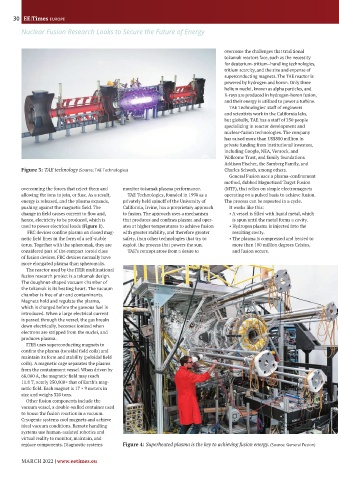
           replace components. Diagnostic systems   Figure 4: Superheated plasma is the key to achieving fusion energy. (Source: General Fusion)

           MARCH 2022 | www.eetimes.eu

