


Page 42 - EE Times Europe Magazine | April2019
P. 42
42 EE|Times EUROPE — Boards & Solutions Insert


         SPECIAL REPORT: AI AT THE EDGE
        Chip Startups for AI in Edge and


        Endpoint Applications

        By Sally Ward-Foxton


               s the industry grapples with the best   company at more than US$1 billion, making it
               way to accelerate artificial-   the first Western semiconductor startup to be
               intelligence performance to keep up   designated a unicorn.
        A with requirements from cutting-edge   The company’s Intelligence Processing Unit
        neural networks, there are many startup com-  (IPU) chip has a massively parallel architec-
        panies springing up around the world with new   ture with more than 1,200 specialized cores,
        ideas about how this is best achieved. They are   which can each run six program threads.
        attracting a lot of venture capital funding, and   There is also substantial on-chip memory
        the result is a sector rich in not just cash but in   — hundreds of megabytes of RAM — plus,
        novel ideas for computing architectures.  importantly, 45 terabytes of memory band-  The Cerebras chip takes up an entire
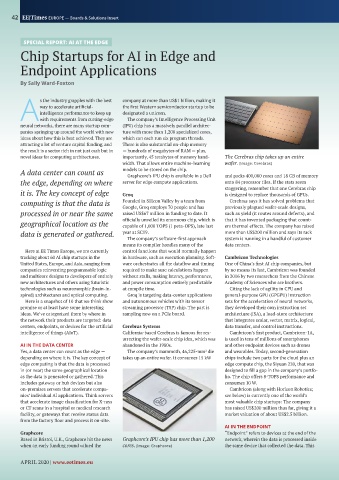
                                            width. That allows entire machine-learning   wafer. (Image: Cerebras)
        A data center can count as          models to be stored on the chip.    and packs 400,000 cores and 18 GB of memory
                                              Graphcore’s IPU chip is available in a Dell
        the edge, depending on where        server for edge compute applications.  onto 84 processor tiles. If the stats seem
        it is. The key concept of edge      Groq                                staggering, remember that one Cerebras chip
                                                                                is designed to replace thousands of GPUs.
                                                                                  Cerebras says it has solved problems that
        computing is that the data is       Founded in Silicon Valley by a team from    previously plagued wafer-scale designs,
                                            Google, Groq employs 70 people and has
        processed in or near the same       raised US$67 million in funding to date. It   such as yield (it routes around defects), and
        geographical location as the        officially unveiled its enormous chip, which is   that it has invented packaging that count-
                                            capable of 1,000 TOPS (1 peta-OPS), late last
                                                                                ers thermal effects. The company has raised
        data is generated or gathered.      year at SC19.                       more than US$200 million and says its rack
                                              The company’s software-first approach   system is running in a handful of customer
                                            means its compiler handles many of the   data centers.
          Here at EE Times Europe, we are currently   control functions that would normally happen
        tracking about 60 AI chip startups in the   in hardware, such as execution planning. Soft-  Cambricon Technologies
        United States, Europe, and Asia, ranging from   ware orchestrates all the dataflow and timing   One of China’s first AI chip companies, but
        companies reinventing programmable logic   required to make sure calculations happen   by no means its last, Cambricon was founded
        and multicore designs to developers of entirely   without stalls, making latency, performance,   in 2016 by two researchers from the Chinese
        new architectures and others using futuristic   and power consumption entirely predictable   Academy of Sciences who are brothers.
        technologies such as neuromorphic (brain-in-  at compile time.            Citing the lack of agility in CPU and
        spired) architectures and optical computing.  Groq is targeting data-center applications   general-purpose GPU (GPGPU) instruction
          Here is a snapshot of 10 that we think show   and autonomous vehicles with its tensor   sets for the acceleration of neural networks,
        promise or at least have some interesting   streaming processor (TSP) chip. The part is   they developed their own instruction set
        ideas. We’ve categorized them by where in   sampling now on a PCIe board.  architecture (ISA), a load-store architecture
        the network their products are targeted: data                           that integrates scalar, vector, matrix, logical,
        centers, endpoints, or devices for the artificial   Cerebras Systems    data transfer, and control instructions.
        intelligence of things (AIoT).      California-based Cerebras is famous for res-  Cambricon’s first product, Cambricon-1A,
                                            urrecting the wafer-scale chip idea, which was   is used in tens of millions of smartphones
        AI IN THE DATA CENTER               abandoned in the 1980s.             and other endpoint devices such as drones
        Yes, a data center can count as the edge —   The company’s mammoth, 46,225-mm  die   and wearables. Today, second-generation
                                                                         2
        depending on where it is. The key concept of   takes up an entire wafer. It consumes 15 kW   chips include two parts for the cloud plus an
        edge computing is that the data is processed                            edge compute chip, the Siyuan 220, that was
        in (or near) the same geographical location                             designed to fill a gap in the company’s portfo-
        as the data is generated or gathered. This                              lio. The chip offers 8-TOPS performance and
        includes gateway or hub devices but also                                consumes 10 W.
        on-premises servers that accelerate compa-                                Cambricon (along with Horizon Robotics;
        nies’ individual AI applications. Think servers                         see below) is currently one of the world’s
        that accelerate image classification for X-rays                         most valuable chip startups: The company
        or CT scans in a hospital or medical research                           has raised US$200 million thus far, giving it a
        facility, or gateways that receive status data                          market valuation of about US$2.5 billion.
        from the factory floor and process it on-site.
                                                                                AI IN THE ENDPOINT
        Graphcore                                                               “Endpoint” refers to devices at the end of the
        Based in Bristol, U.K., Graphcore hit the news   Graphcore’s IPU chip has more than 1,200   network, wherein the data is processed inside
        when an early funding round valued the   cores. (Image: Graphcore)      the same device that collected the data. This

        APRIL 2020 | www.eetimes.eu

