


Page 34 - EE Times Europe Magazine | April2019
P. 34
34 EE|Times EUROPE


         MEDICAL
        Addressing the Challenges of Designing


        for Medical Markets

        By Maurizio Di Paolo Emilio


             rogress in electronics technology has made it possible to create
             increasingly safe, compact medical devices with the lowest
             degree of invasiveness, but challenges remain in meeting strict
       Psafety standards, providing wireless connectivity, and operating
        within highly constricted power budgets.
          An electromedical device is defined as an electronic device with
        a part that can be applied directly to the subject or used to transfer
        energy to or from the patient. Applications include diagnosis, treat-
        ment, and monitoring of the patient’s health conditions, as well as
        alleviating or even eliminating pain.
          Safety, both for the patient and health-care professionals, is the
        first requirement with which an electromedical device must comply.
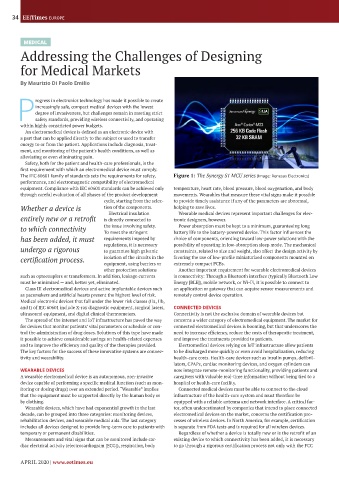
        The IEC 60601 family of standards sets the requirements for safety,   Figure 1: The Synergy S1 MCU series (Image: Renesas Electronics)
        performance, and electromagnetic compatibility of electromedical
        equipment. Compliance with IEC 60601 standards can be achieved only   temperature, heart rate, blood pressure, blood oxygenation, and body
        through careful evaluation of all phases of the product development   movements. Wearables that measure these vital signs make it possible
                                      cycle, starting from the selec-  to provide timely assistance if any of the parameters are abnormal,
        Whether a device is           tion of the components.  helping to save lives.
                                       Electrical insulation
                                                                Wearable medical devices represent important challenges for elec-
        entirely new or a retrofit    is directly connected to   tronic designers, however.
                                                                Power absorption must be kept to a minimum, guaranteeing long
        to which connectivity         the issue involving safety.   battery life to the battery-powered device. This factor influences the
                                      To meet the stringent
        has been added, it must       requirements imposed by   choice of components, orienting toward low-power solutions with the
        undergo a rigorous            regulations, it is necessary   possibility of operating in low-absorption sleep mode. The mechanical
                                                              constraints, related to size and weight, also affect the design activity by
                                      to guarantee high galvanic
        certification process.        isolation of the circuits in the   favoring the use of low-profile miniaturized components mounted on
                                      equipment, using barriers or   extremely compact PCBs.
                                      other protection solutions   Another important requirement for wearable electromedical devices
        such as optocouplers or transformers. In addition, leakage currents   is connectivity: Through a Bluetooth interface (typically Bluetooth Low
        must be minimized — and, better yet, eliminated.      Energy [BLE]), mobile network, or Wi-Fi, it is possible to connect to
          Class III electromedical devices and active implantable devices such   an application or gateway that can acquire sensor measurements and
        as pacemakers and artificial hearts present the highest level of risk.   remotely control device operation.
        Medical electronic devices that fall under the lower risk classes (IIa, IIb,
        and I) of IEC 60601 include X-ray diagnostic equipment, surgical lasers,   CONNECTED DEVICES
        ultrasound equipment, and digital clinical thermometers.  Connectivity is not the exclusive domain of wearable devices but
          The spread of the internet and IoT infrastructure has paved the way   concerns a wider category of electromedical equipment. The market for
        for devices that monitor patients’ vital parameters or schedule or con-  connected electromedical devices is booming, but that underscores the
        trol the administration of drug doses. Solutions of this type have made   need to increase efficiency, reduce the costs of therapeutic treatment,
        it possible to achieve considerable savings on health-related expenses   and improve the treatments provided to patients.
        and to improve the efficiency and quality of the therapies provided.    Electromedical devices relying on IoT infrastructure allow patients
        The key factors for the success of these innovative systems are connec-  to be discharged more quickly or even avoid hospitalization, reducing
        tivity and wearability.                               health-care costs. Health-care devices such as insulin pumps, defibril-
                                                              lators, CPAPs, cardiac monitoring devices, and oxygen cylinders can
        WEARABLE DEVICES                                      now integrate remote-monitoring functionality, providing patients and
        A wearable electromedical device is an autonomous, non-invasive   caregivers with valuable real-time information without being tied to a
        device capable of performing a specific medical function (such as mon-  hospital or health-care facility.
        itoring or dosing drugs) over an extended period. “Wearable” implies   Connected medical devices must be able to connect to the cloud
        that the equipment must be supported directly by the human body or   infrastructure of the health-care system and must therefore be
        by clothing.                                          equipped with a reliable antenna and network interface. A critical fac-
          Wearable devices, which have had exponential growth in the last   tor, often underestimated by companies that intend to place connected
        decade, can be grouped into three categories: monitoring devices,   electromedical devices on the market, concerns the certification pro-
        rehabilitation devices, and wearable medical aids. The last category   cesses of wireless devices. In North America, for example, certification
        includes all devices designed to provide long-term care to patients with   is separate from FDA tests and is required for all wireless devices.
        temporary or permanent disabilities.                    Regardless of whether a device is totally new or is the retrofit of an
          Measurements and vital signs that can be monitored include car-  existing device to which connectivity has been added, it is necessary
        diac electrical activity (electrocardiogram [ECG]), respiration, body   to go through a rigorous certification process not only with the FCC

        APRIL 2020 | www.eetimes.eu

