


Page 30 - EE Times Europe Magazine | April2019
P. 30
30 EE|Times EUROPE


         INTERNET OF THINGS
        Efficiency and Energy Savings with


        Networked Lighting Control

        By Maurizio Di Paolo Emilio


              he main functionality of a lighting
              system is to provide a space with the
              amount and quality of illumination
        T appropriate for the specific context
        while minimizing energy consumption.
        Lighting control strategies that sense and
        respond to the presence of occupants, and
        that adjust the output of artificial lighting
        as daylight conditions change, can substan-
        tially reduce electricity use compared with
        traditional lighting systems.
          The pairing of LED lighting with wired or
        wireless network communication has allowed
        the creation of intelligent lighting control
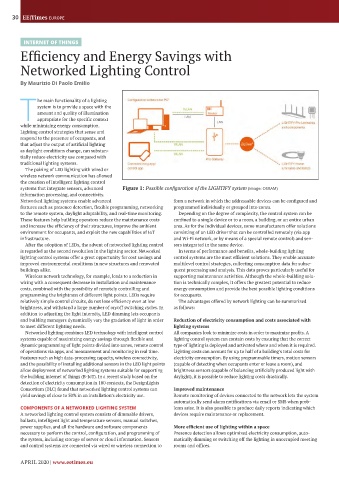
        systems that integrate sensors, advanced   Figure 1: Possible configuration of the LIGHTIFY system (Image: OSRAM)
        information processing, and connectivity.
        Networked lighting systems enable advanced            form a network in which the addressable devices can be configured and
        features such as presence detection, flexible programming, networking   programmed individually or grouped into zones.
        to the remote system, daylight adaptability, and real-time monitoring.   Depending on the degree of complexity, the control system can be
        These features help building operators reduce the maintenance costs   confined to a single device or to a room, a building, or an entire urban
        and increase the efficiency of their structures, improve the ambient   area. As for the individual devices, some manufacturers offer solutions
        environment for occupants, and exploit the new capabilities of IoT   consisting of an LED driver that can be controlled remotely (via app
        infrastructure.                                       and Wi-Fi network, or by means of a special remote control) and sen-
          After the adoption of LEDs, the advent of networked lighting control   sors integrated in the same device.
        is regarded as the second revolution in the lighting sector. Networked   In terms of performance and benefits, whole-building lighting
        lighting control systems offer a great opportunity for cost savings and   control systems are the most efficient solutions. They enable accurate
        improved environmental conditions in new structures and renovated   multilevel control strategies, collecting consumption data for subse-
        buildings alike.                                      quent processing and analysis. This data proves particularly useful for
          Wireless network technology, for example, leads to a reduction in   supporting maintenance activities. Although the whole-building solu-
        wiring with a consequent decrease in installation and maintenance   tion is technically complex, it offers the greatest potential to reduce
        costs, combined with the possibility of remotely controlling and   energy consumption and provide the best possible lighting conditions
        programming the brightness of different light points. LEDs require   for occupants.
        relatively simple control circuits, do not lose efficiency even at low   The advantages offered by network lighting can be summarized
        brightness, and withstand a large number of on/off switching cycles. In   as follows:
        addition to adjusting the light intensity, LED dimming lets occupants
        and building managers dynamically vary the gradation of light in order   Reduction of electricity consumption and costs associated with
        to meet different lighting needs.                     lighting systems
          Networked lighting combines LED technology with intelligent control   All companies look to minimize costs in order to maximize profits. A
        systems capable of maximizing energy savings through flexible and   lighting control system can contain costs by ensuring that the correct
        dynamic programming of light points divided into zones, remote control   type of lighting is deployed and activated where and when it is required.
        of operations via apps, and measurement and monitoring in real time.   Lighting costs can account for up to half of a building’s total costs for
        Features such as high data-processing capacity, wireless connectivity,   electricity consumption. By using programmable timers, motion sensors
        and the possibility of installing additional sensors in the LED light points   (capable of detecting when occupants enter or leave a room), and
        allow deployment of networked lighting systems suitable for supporting   brightness sensors (capable of balancing artificially produced light with
        the building internet of things (B-IoT). In a recent study based on the   daylight), it is possible to reduce lighting costs drastically.
        detection of electricity consumption in 100 contexts, the DesignLights
        Consortium (DLC) found that networked lighting control systems can   Improved maintenance
        yield savings of close to 50% in an installation’s electricity use.   Remote monitoring of devices connected to the network lets the system
                                                              automatically send alarm notifications via email or SMS when prob-
        COMPONENTS OF A NETWORKED LIGHTING SYSTEM             lems arise. It is also possible to produce daily reports indicating which
        A networked lighting control system consists of dimmable drivers,   devices require maintenance or replacement.
        ballasts, intelligent light and temperature sensors, manual switches,
        power supplies, and all the hardware and software components   More efficient use of lighting within a space
        necessary to perform the control, configuration, and programming of   Presence detection allows optimized electricity consumption, auto-
        the system, including storage of server or cloud information. Sensors   matically dimming or switching off the lighting in unoccupied meeting
        and control systems are connected via wired or wireless connection to   rooms and offices.

        APRIL 2020 | www.eetimes.eu

