


Page 47 - EE Times Europe Magazine | February 2020
P. 47
EE|Times EUROPE — Boards & Solutions Insert   45
                                                       PCB Design Hints for Improving IGBT Thermal Performance


                                                                                    of pads made on the PCB (Figure 2) and kept
                                                                                    operative for a time that’s sufficient to reach a
                                                                                    stable temperature.
                                                                                      The test was conducted using a PCB with
                                                                                    five types of pads, each with its own thermal
                                                                                    conduction (Figure 2). More precisely, the
                                                                                    test used:
                                                                                      •  a pad in which there is no heat conduc-
                                                                                       tion path from the collector of the IGBT
                                                                                       to the PCB (PAD 0);
                                                                                      •  a pad with the same area as the IGBT
                                                                                       package (PAD 1)
                                                                                      •  a pad with the same area as the IGBT
                                                                                       (PAD 2); and
                                                                                      •  two pads with the recommended pad
                                                                                       area for the specific device, without
                                                                                       (PAD 3) and with thermal heat spreads
                                                                                       from the top to the bottom of the PCB
                                                                                       (PAD 4).
                                                                                      To quantify the improvement in thermal
                                                                                    performance attributable to a lower   ce(ON) ,
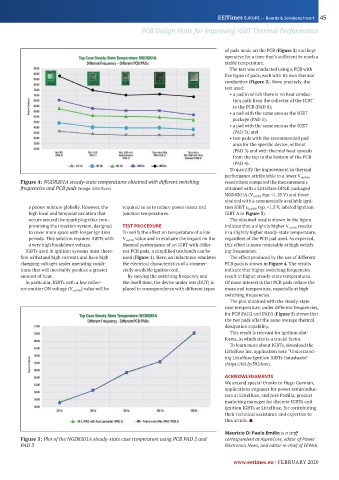
            Figure 4: NGD8201A steady-state temperatures obtained with different switching    researchers compared the measurements
            frequencies and PCB pads (Image: Littelfuse)                            obtained with a Littelfuse DPAK-packaged
                                                                                    NGD 201A (  ce(ON)  typ.  1.    ) and those
                                                                                    obained with a commercially available igni-
               a poorer mixture globally.  owever, the   required so as to reduce power losses and   tion IGBT ( Vce(ON)  typ.  1.   , labeled Ignition
               high local and temporal variation that   junction temperatures.      IGBT A in Figure 3).
               occurs around the spark plug risks com-                                The obtained results shown in the figure
               promising the injection system, designed   TEST PROCEDURE            indicate that a slightly higher   ce(ON)  results
               to cover more space with longer ignition   To verify the effect on temperature of a low   in a slightly higher steady-state temperature,
               periods. This solution requires IGBTs with   V ce(ON)  value and to evaluate the impact on the   regardless of the PCB pad used. As expected,
               a very high breakdown voltage.   thermal performance of an IGBT with differ-  this effect is more noticeable at high switch-
              IGBTs used in ignition systems must there-  ent PCB pads, a simplified testbench can be   ing frequencies.
            fore withstand high currents and have high   used (Figure 1). Here, an inductance emulates   The effect produced by the use of different
            clamping voltages under operating condi-  the electrical characteristics of a commer-  PCB pads is shown in Figure 4. The results
            tions that will inevitably produce a greater   cially available ignition coil.   indicate that higher switching frequencies
            amount of heat.                       By varying the switching frequency and   result in higher steady-state temperatures.
              In particular, IGBTs with a low collec-  the dwell time, the device under test (DUT) is   Of more interest is that PCB pads reduce the
            tor-emitter ON voltage (  ce(ON) ) value will be   placed in correspondence with different types   measured temperature, especially at high
                                                                                    switching frequencies.
                                                                                      The plot obtained with the steady-state
                                                                                    case temperature, under different frequencies,
                                                                                    for PCB PAD2 and PAD3 (Figure 5) shows that
                                                                                    the two pads offer the same average thermal
                                                                                    dissipation capability.
                                                                                      This result is relevant for ignition plat-
                                                                                    forms, in which size is a crucial factor.
                                                                                      To learn more about IGBTs, download the
                                                                                    Littelfuse Inc. application note “Understand-
                                                                                    ing Littelfuse Ignition IGBTs Datasheets”
                                                                                    (https://bit.ly/392deov).
                                                                                    ACKNOWLEDGMENTS
                                                                                    We extend special thanks to  ugo Guzm n,
                                                                                    applications engineer for power semiconduc-
                                                                                    tors at Littelfuse, and  os  Padilla, product
                                                                                    marketing manager for discrete IGBTs and
                                                                                    ignition IGBTs at Littelfuse, for contributing
                                                                                    their technical assistance and expertise to
                                                                                    this article. ■

                                                                                    Maurizio Di Paolo Emilio is a staff
            Figure 5: Plot of the NGD8201A steady-state case temperature using PCB PAD 2 and   correspondent at AspenCore, editor of Power
            PAD 3                                                                   Electronics News, and editor-in-chief of EEWeb.

                                                                                       www.eetimes.eu | FEBRUARY 2020

