


Page 42 - EE Times Europe Magazine | February 2020
P. 42
40 EE|Times EUROPE — Boards & Solutions Insert


              SYSTEMS-ON-CHIP
            Intel Cryogenic Chip to Facilitate Development

            of  uantum Computing


            By Maurizio Di Paolo Emilio


              ntel has unveiled a new hardware solution focused on quantum
              computing   orse Ridge is the fi rst cryogenically controlled proces-
              sor designed to accelerate the development of full-stack quantum
           Icomputing systems.
              Quantum computers promise to address problems that conventional
            computing solutions cannot handle. The underlying technology is   Figure 1:
            quantum physics  because a quantum bit (or qubit) can exist simul-  Google quantum computers
            taneously in multiple states, it can be used to conduct multiple
            calculations at the same time, signifi cantly speeding up the resolution
            of complex problems.                                     im Clarke, director of quantum hardware at Intel, explained that,
              At the beginning of the development of quantum computing, scien-  until now, much emphasis has been placed on the qubit itself, but one
            tists focused on the realization of qubits. If we imagine the bit like a   of the main challenges is the simultaneous control of multiple qubits.
            coin that, once tossed, can reveal its face with the value 1 or 0, a qubit   Intel’s new chip simplifi es the design and size of quantum computers.
            is a coin that spins like a top — allowing it to have more values simul-   orse Ridge is a highly integrated mixed-signal system-on-chip
            taneously — until it is stopped to read the measured value. Intel and   (SoC) that reduces the complexity of quantum control engineering.
            several other organizations are pursuing silicon quantum processors   It is programmed with instructions that correspond to basic qubit
            that measure the property of electron spin.           operations. The SoC translates these instructions into electromagnetic
              Quantum computers can perform multiple calculations at the same   microwave pulses that can manipulate the state of the qubits.
            time, but in doing so, they generate excessive amounts of heat. Con-  A quantum computer works in the milliKelvin range, which is only
            sequently, to be effective, they must operate at temperatures close to   a fraction of a degree above absolute zero. Silicon spin qubits have
            absolute zero (i.e., very close to  2  .1  C).        properties that could allow them to operate at 1-Kelvin-or-higher
              These devices, which are often custom-designed, tend to require hun-  temperatures, which would drastically reduce the cooling challenges of
            dreds of cables in and out of the cryogenic fridge to control the quantum   quantum technology.
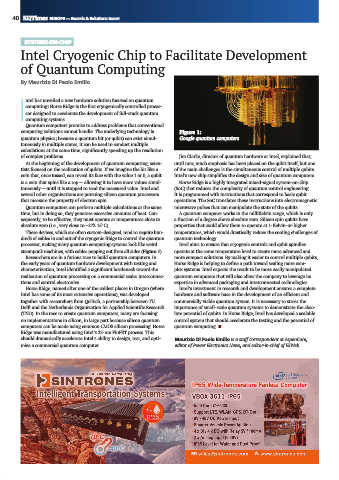
            processor, making many quantum computing systems look like weird   Intel aims to ensure that cryogenic controls and qubit spindles
            steampunk machines, with cables popping out from all sides (Figure 1).  operate at the same temperature level to create more advanced and
              Researchers are in a furious race to build quantum computers. In   more compact solutions. By making it easier to control multiple qubits,
            the early years of quantum hardware development with testing and    orse Ridge is helping to defi ne a path toward scaling more com-
            characterization, Intel identifi ed a signifi cant bottleneck toward the   plex systems. Intel expects the result to be more easily manipulated
            realization of quantum processing on a commercial scale  interconnec-  quantum computers that will also allow the company to leverage its
            tions and control electronics.                        expertise in advanced packaging and interconnected technologies.
               orse Ridge, named after one of the coldest places in Oregon (where   Intel’s investment in research and development ensures a complete
            Intel has some of its most extensive operations), was developed   hardware and software base in the development of an effi cient and
            together with researchers from  uTech, a partnership between TU   commercially viable quantum system. It is necessary to stress the
            Delft and the Netherlands Organization for Applied Scientifi c Research   importance of small-scale quantum systems to demonstrate the abso-
            (TNO). In the race to create quantum computers, many are focusing   lute potential of qubits. In  orse Ridge, Intel has developed a scalable
            on implementations in silicon, in large part because silicon quantum   control system that should accelerate the testing and the potential of
            computers can be made using common CMOS silicon processing.  orse   quantum computing. ■
            Ridge was manufactured using Intel’s 22-nm FinFET process. This
            should dramatically accelerate Intel’s ability to design, test, and opti-  Maurizio Di Paolo Emilio is a staff  correspondent at AspenCore
            mize a commercial quantum computer.                   editor o   o er   ectronics  e s  and editor in c ie  o     e .

