


Page 32 - PEN eBook May 2023
P. 32
SEMICONDUCTORS                                                                                                                                                                                                  SEMICONDUCTORS

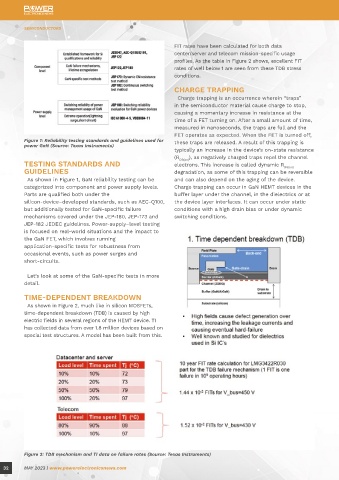
                                                              FIT rates have been calculated for both data                                                                           HOT CARRIER DEGRADATION
                                                              center/server and telecom mission-specific usage                                                                        Hot carriers generated through current flow at high
                                                              profiles. As the table in Figure 2 shows, excellent FIT                                                                voltages can cause both charge trapping (resulting in
                                                              rates of well below 1 are seen from these TDB stress                                                                   dynamic R DS(on)  increases) and create device
                                                              conditions.                                                                                                            wear-out due to defect generation. The JEP-180
                                                                                                                                                                                     guideline enables a switching lifetime to be determined
                                                              CHARGE TRAPPING

                                                               Charge trapping is an occurrence wherein “traps”
                                                              in the semiconductor material cause charge to stop,
                                                              causing a momentary increase in resistance at the
                                                              time of a FET turning on. After a small amount of time,
                                                              measured in nanoseconds, the traps are full and the
                                                              FET operates as expected. When the FET is turned off,
          Figure 1: Reliability testing standards and guidelines used for   these traps are released. A result of this trapping is
          power GaN (Source: Texas Instruments)
                                                              typically an increase in the device’s on-state resistance
                                                              (R DS(on) ), as negatively charged traps repel the channel
          TESTING STANDARDS AND                               electrons. This increase is called dynamic R
                                                                                                     DS(on)
          GUIDELINES                                          degradation, as some of this trapping can be reversible
           As shown in Figure 1, GaN reliability testing can be   and can also depend on the aging of the device.
          categorized into component and power supply levels.   Charge trapping can occur in GaN HEMT devices in the
          Parts are qualified both under the                  buffer layer under the channel, in the dielectrics or at
          silicon-device–developed standards, such as AEC-Q100,   the device layer interfaces. It can occur under static
          but additionally tested for GaN-specific failure    conditions with a high drain bias or under dynamic
          mechanisms covered under the JEP-180, JEP-173 and   switching conditions.
          JEP-182 JEDEC guidelines. Power-supply–level testing
          is focused on real-world situations and the impact to
          the GaN FET, which involves running
          application-specific tests for robustness from
          occasional events, such as power surges and
          short-circuits.


           Let’s look at some of the GaN-specific tests in more
          detail.

          TIME-DEPENDENT BREAKDOWN
           As shown in Figure 2, much like in silicon MOSFETs,                                                                   Figure 3: GaN charge trapping mechanism and dynamic R DS(on)
          time-dependent breakdown (TDB) is caused by high                                                                       measurements from TI (Source: Texas Instruments)
          electric fields in several regions of the HEMT device. TI
          has collected data from over 1.8 million devices based on                                                               Low-duty–cycle, hard-switch testing can provide
          special test structures. A model has been built from this.                                                             higher sensitivity for dynamic R DS(on)  degradation. As
                                                                                                                                 shown in Figure 3, TI uses a test vehicle listed in the
                                                                                                                                 JEP-182 standard to provide a continuous
                                                                                                                                 hard-switching stress based on the maximum power
                                                                                                                                 condition, the maximum recommended drain voltage
                                                                                                                                 (V ) and the worst-case junction temperature. These
                                                                                                                                  DS
                                                                                                                                 conditions are per the JEP-180 guidelines.

                                                                                                                                  The data over 1,000 hours of stress testing at a
                                                                                                                                 duty cycle of 0.5% is shown in Figure 3. This shows
                                                                                                                                 a stable R DS(on)  behavior with device aging. A static
                                                                                                                                 off-state stress of 500-V V  at 125°C on the LMG341x
                                                                                                                                                        DS
                                                                                                                                 GaN product similarly shows no R DS(on)  degradation.
                                                                                                                                 This stable R DS(on)  behavior in TI’s GaN devices comes
                                                                                                                                 from many years of process flow improvements in key   Figure 4: The DHTOL guideline of JEP-180 validates reliability
                                                                                                                                 process steps like epi-growth as well as creating   for stresses of the relevant target application (Source: Texas
          Figure 2: TDB mechanism and TI data on failure rates (Source: Texas Instruments)                                       trap-free dielectrics and interfaces.               Instruments)

  32      MAY 2023 | www.powerelectronicsnews.com                                                                                                                                                  MAY 2023 | www.powerelectronicsnews.com  33

