


Page 27 - PEN eBook May 2023
P. 27
SEMICONDUCTORS                                                                                    SEMICONDUCTORS


 Figure 1: Solar panel application (Source: onsemi)


 or a hybrid IGBT [Si IGBT + SiC diode] or a full-SiC   “Level 1 is typically 120 V AC, is single-phase and
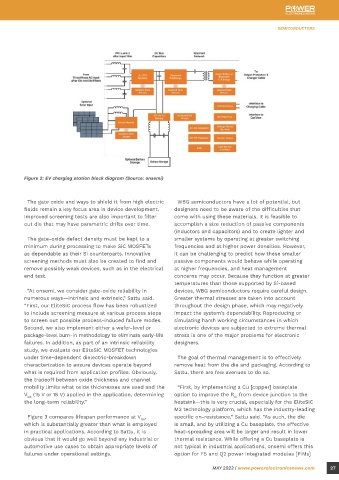
 [SiC MOSFET + SiC diode] solution. While hybrid   typically comes from a household outlet with max   Figure 2: EV charging station block diagram (Source: onsemi)
 solutions have become common already, SiC-based   current rating of 15–20 A and very slow charge rate,”
 full solutions will challenge them as SiC wafer   Sattu said. “Level 2 is 220 V AC, is available at home,
 costs reduce in the coming years. Assume that the   workplace or public locations and adds 12–80 miles   The gate oxide and ways to shield it from high electric   WBG semiconductors have a lot of potential, but
 system-level conditions are 500 V/25 A, F  of 16 kHz   per hour, depending on the power output level.   fields remain a key focus area in device development.   designers need to be aware of the difficulties that
 sw
 and output voltage of 800 V with a 600-µH boost   Level 2 chargers can deliver up to 7.7–11 kW, making   Improved screening tests are also important to filter   come with using these materials. It is feasible to
 inductor.”  them capable of charging the average EV in about two   out die that may have parametric drifts over time.  accomplish a size reduction of passive components
 to eight hours. The much larger DC quick chargers are        (inductors and capacitors) and to create lighter and
 According to Sattu, from Table 1, comparing a   Level 3 and only available at commercial locations that   The gate-oxide defect density must be kept to a   smaller systems by operating at greater switching
 hybrid-IGBT solution and full-SiC solution, it’s clear   have access to three-phase power from their local   minimum during processing to make SiC MOSFETs   frequencies and at higher power densities. However,
 that under the same conditions, overall losses are   utility provider. These systems can add up to 100 miles   as dependable as their Si counterparts. Innovative   it can be challenging to predict how these smaller
 significantly better in a full-SiC solution, resulting in   or more of range to an EV battery in just   screening methods must also be created to find and   passive components would behave while operating
 better efficiency.  30 minutes. Let’s look at a typical EV charging station   remove possibly weak devices, such as in the electrical   at higher frequencies, and heat management
 block diagram in Figure 2. Let’s take the example of a   end test.  concerns may occur. Because they function at greater
 “However, with SiC full modules, the switching   DC fast charger at the system level. On the front end,   temperatures than those supported by Si-based
 frequencies can be increased 40 kHz or higher,   there is a three-phase power-factor–correction [PFC]   “At onsemi, we consider gate-oxide reliability in   devices, WBG semiconductors require careful design.
 resulting in the boost inductor to be as low as   boost stage, implemented in a variety of topologies,   numerous ways—intrinsic and extrinsic,” Sattu said.   Greater thermal stresses are taken into account
 200 µH, resulting in lower cost and weight,” Sattu   such as two-level, three-level, uni- or bidirectional.   “First, our EliteSiC process flow has been robustized   throughout the design phase, which may negatively
 said.  The voltage levels from the grid 400 [EU]/480 [U.S.] are   to include screening measure at various process steps   impact the system’s dependability. Reproducing or
 boosted up to 700–1,000 V. A subsequent DC/DC isolated   to screen out possible process-induced failure modes.   simulating harsh working circumstances in which
 stage converts the bus voltage into the required output   Second, we also implement either a wafer-level or   electronic devices are subjected to extreme thermal
 Parameter  PIM-IGBT  PIM-SiC  voltage. The output voltage aligns with EV battery   package-level burn-in methodology to eliminate early-life   stress is one of the major problems for electronic
 Conduction Loss  13.33 W  12.17 W  voltages, typically 400 V or 800 V, and needs to cover   failures. In addition, as part of an intrinsic reliability   designers.
 Switching Frequency  16 kHz  16 kHz  the voltage charging profiles. Therefore, the DC/DC   study, we evaluate our EliteSiC MOSFET technologies
                                                               The goal of thermal management is to effectively
 Turn On Loss E on  3.8 W  3.17 W  output range might swing from 150 V up to 1,500 V.   under time-dependent dielectric-breakdown   remove heat from the die and packaging. According to
          characterization to ensure devices operate beyond
 The value proposition of SiC MOSFETs comes into
 Turn Off E off  34.66 W  3.06 W  the picture here. To accommodate the bidirectional   what is required from application profiles. Obviously,   Sattu, there are few avenues to do so.
 Total Loss  51.79 W  18.39 W  charge/discharge process and wide voltage range of   the tradeoff between oxide thickness and channel
 T (T  = 95°C)  137.9°C  109.9°C  EV batteries, IGBTs are replaced with SiC MOSFET   mobility limits what oxide thicknesses are used and the   “First, by implementing a Cu [copper] baseplate
 j  c
 solutions.”  V  (15 V or 18 V) applied in the application, determining   option to improve the R  from device junction to the
                                                                                   th
           GS
 Table 1: Comparing a hybrid-IGBT solution and full-SiC   the long-term reliability.”  heatsink—this is very crucial, especially for the EliteSiC
 solution (Source: onsemi)  DESIGN CHALLENGES                 M3 technology platform, which has the industry-leading
 A number of basic long-term effectiveness concerns   Figure 3 compares lifespan performance at V ,   specific on-resistance,” Sattu said. “As such, the die
                                                  GS
 The second key focus area is EV chargers. According   based on SiC quality, dependability and supply arise as   which is substantially greater than what is employed   is small, and by utilizing a Cu baseplate, the effective
 to Sattu, the EV chargers of today fall into three main   an increasing number of designers are presently using   in practical applications. According to Sattu, it is   heat-spreading area will be larger and result in lower
 categories, separated mainly by their voltage input   or have previously used SiC in their designs. With the   obvious that it would go well beyond any industrial or   thermal resistance. While offering a Cu baseplate is
 and power level.  commercialization and evolution of SiC MOSFETs,   automotive use cases to obtain appropriate levels of   not typical in industrial applications, onsemi offers this
 gate-oxide reliability has improved significantly as well.  failures under operational settings.  option for F5 and Q2 power integrated modules [PIMs]

 26  MAY 2023 | www.powerelectronicsnews.com                                MAY 2023 | www.powerelectronicsnews.com  27

