


Page 23 - PEN eBook October 2022
P. 23
Test & Measurement                                                                     MOTOR CONTROL


 ▶   Digital I/Os to enable ECU and other signal emulation
 ▶   Analog I/Os to measure voltage, current, strain, or other physical variables involved in
 battery testing


 The  hardware  abstraction  layer  of  the  BTS  allows  different  instrumentation  to  contribute  to
 the  overall  system.  It  is  straightforward to  swap  in/out  items  of test  hardware when  required,
 irrespective of the vendor or the models, without further modification of the test system being
 called for. Aliases enable this swapping while eliminating the need to alter test scripts or remap
 the test software, which would otherwise prove time-consuming.


 Pre-programmed test steps and use-case examples mean that it is not necessary to start the   Brushed DC Motor
 test setup from scratch. Implementation can therefore be completed much more quickly. NI has

 successfully built up, and continues to expand, the ecosystem of partners who can assist here.   Programmable Speed
 These can work with customers to configure solutions so that they are fully optimized for specific
 application criteria.  Regulator

 CONCLUSION

 The automotive sector has to migrate away from a siloed approach whereby data is derived from test   By Nazar Sliunchenko, technical documentation manager at Renesas
 systems that lack compatibility with another and are consequently isolated. Instead, they need an   Electronics

 open and fully connected platform that can encompass all their test assets. This must also be both
 scalable and upgradeable. By adopting NI’s BTS and using it to orchestrate test operations, automakers   This article describes how to design and build a low-noise, high-performance, low-cost brushed
 will have a single point of contact via which all the battery tests they are conducting may be routed,   DC motor programmable speed regulator. The regulator is immune to the temperature, voltage, and
 interfacing with facilities in numerous geographic locations. This will allow them to shorten the time   motor load variation. Also, this circuit is not sensitive to the motor coil resistance, which allows
 and engineering effort that goes into the commissioning and configuration of test systems. It will also   using different motors in the same application without any adjustments.
 bring major advantages when it comes to ramping up their test activities as customer demand grows.
                                                               The  described  circuit  is  designed  specifically
                                                               for devices in which a low-power brushed DC
                                                               motor is used and in  which  the stability of

                                                               the motor speed and low noise are critical.
                                                               The motor speed is pre-programmed and does
                                                               not require trimming after assembly, though it
                                                               is possible to reprogram it to a different speed
                                                               via I C.
                                                                   2

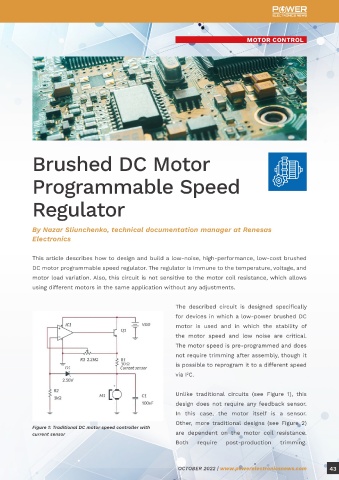
                                                               Unlike  traditional  circuits  (see  Figure  1),  this

                                                               design does not require any feedback sensor.
                                                               In  this  case,  the  motor  itself  is  a  sensor.
                                                               Other,  more traditional  designs  (see  Figure  2)
            Figure 1: Traditional DC motor speed controller with
            current sensor                                     are dependent on  the motor coil resistance.
                                                               Both   require   post-production    trimming.


 42  OCTOBER 2022 | www.powerelectronicsnews.com                OCTOBER 2022 | www.powerelectronicsnews.com          43

