


Page 19 - PEN eBook October 2022
P. 19
DESIGN                                                                                              Design


            This article  will present  the challenges  faced by electronic engineers  when designing  these new
            illumination products, focus on selecting the correct LED driver for a multi-beam headlamp, and review
            how adaptive feedback control (AFC) improves thermal management. These topics will be explained

            through the design of a multi-beam headlight, from a high-level system overview to LED driver selection.

                                                                         MATRIX HEADLAMP

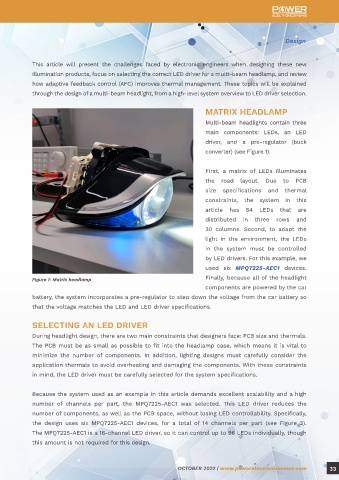
                                                                         Multi-beam headlights contain three
                                                                         main  components:  LEDs,  an  LED
                                                                         driver,  and  a  pre-regulator  (buck
                                                                         converter) (see Figure 1).


                                                                         First,  a  matrix  of  LEDs  illuminates

                                                                         the  road  layout.  Due  to  PCB
                                                                         size  specifications  and  thermal
 Designing                                                               constraints,  the  system  in  this

                                                                         article  has  84  LEDs  that  are
 Cooler-Running,                                                         distributed in  three rows and
                                                                         30  columns.  Second,  to  adapt  the
                                                                         light  in  the  environment,  the  LEDs
 Multichannel Dynamic                                                    in  the system must be controlled


                                                                         by LED drivers. For this example, we
 Automotive Lights  Figure 1: Matrix headlamp                            used six  MPQ7225-AEC1 devices.

                                                                         Finally, because all of the headlight
                                                                         components are powered by the car
 By Oster Hsu, applications engineer; Xavier Ribas, applications engineer; and   battery, the system incorporates a pre-regulator to step down the voltage from the car battery so
 Junjian Zhao, manager of technical marketing and applications engineer, all   that the voltage matches the LED and LED driver specifications.
 at Monolithic Power Systems
            SELECTING AN LED DRIVER

 Across the automotive landscape, the push for electrification has yielded the incredible proliferation of   During headlight design, there are two main constraints that designers face: PCB size and thermals.
 exotic vehicles. Yesterday’s bulky, single-function lights are being replaced with newer, slender designs   The PCB must be as small as possible to fit into the headlamp case, which means it is vital to
 that wrap around a car’s front, back, or sides. The drive to go beyond traditional illumination or signaling   minimize  the  number  of  components.  In  addition,  lighting  designs  must  carefully  consider  the
 means that tomorrow’s automotive lights will be challenged to display sophisticated patterns and   application thermals to avoid overheating and damaging the components. With these constraints
 algorithms while facing unprecedented constraints in thermal management, form factor, and cost.  in mind, the LED driver must be carefully selected for the system specifications.


 An example of these new products are adaptive headlights, also known as matrix headlights. These   Because the system used as an example in this article demands excellent scalability and a high

 headlamps substitute old light bulbs using a matrix of numerous LEDs, which improves thermals and   number  of  channels  per  part,  the  MPQ7225-AEC1  was  selected.  This  LED  driver  reduces  the
 increases light beam control. Each LED of this matrix is controlled independently to create innovative   number of components, as well as the PCB space, without losing LED controllability. Specifically,
 and  fascinating  light  designs  that  improve  the  driver’s  visibility  and  adjust  the  light  beam  to  the   the  design  uses  six  MPQ7225-AEC1  devices,  for  a  total  of  14  channels  per  part  (see  Figure  2).
 environment. By switching off the unnecessary light elements and keeping the rest of the area fully lit,   The MPQ7225-AEC1 is a 16-channel LED driver, so it can control up to 96 LEDs individually, though
 headlamps can illuminate what drivers need to see without distracting other road users.  this amount is not required for this design.


 32  OCTOBER 2022 | www.powerelectronicsnews.com                OCTOBER 2022 | www.powerelectronicsnews.com          33

