


Page 19 - PEN eBook NOVEMBER 2022
P. 19
AUTOMOTIVE                                                                                            AUTOMOTIVE

          WIRED BATTERY CONNECTIONS:                          THE DISADVANTAGE OF A WIRED BMS
          THE COSTLY, HEAVY, AND COMPLEX                       However, there is also a list of disadvantages related
          APPROACH                                            to wires: A copper wiring harness adds additional
           The intention for the wBMS technology development   weight and occupies space that, if filled by a battery
          was based on an analysis of the drawbacks of the    cell, would provide extra energy capacity. Additionally,
          communications wiring in today’s conventional EV    the wiring needs to be fastened on battery housing
          battery packs. This analysis drew on ADI’s expertise:   structures and connectors can potentially suffer from
          It supplies the market’s most accurate BMS ICs in the   a mechanical failure, especially under vibration and
          wireless communications field. ADI also developed the   shock conditions.
          world’s most robust mesh networking technology for
          industrial environments.                             In other words, wires increase development effort,
                                                              manufacturing cost, and weight while also reducing
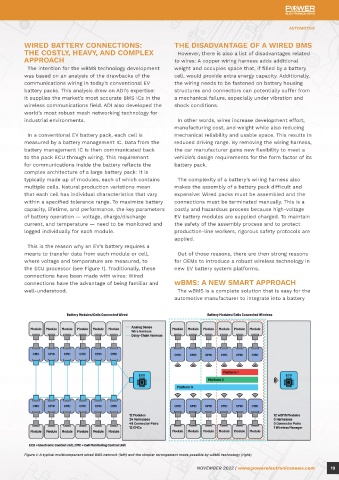
           In a conventional EV battery pack, each cell is    mechanical reliability and usable space. This results in
          measured by a battery management IC. Data from the   reduced driving range. By removing the wiring harness,
          battery management IC is then communicated back     the car manufacturer gains new flexibility to meet a
          to the pack ECU through wiring. This requirement    vehicle’s design requirements for the form factor of its
          for communications inside the battery reflects the   battery pack.
          complex architecture of a large battery pack: It is
          typically made up of modules, each of which contains   makes the assembly of a battery pack difficult and
                                                               The complexity of a battery’s wiring harness also
          multiple cells. Natural production variations mean
 Wireless BMS Enables   that each cell has individual characteristics that vary   expensive: Wired packs must be assembled and the
          within a specified tolerance range. To maximize battery
                                                              connections must be terminated manually. This is a
 Smart Battery   capacity, lifetime, and performance, the key parameters   costly and hazardous process because high-voltage
                                                              EV battery modules are supplied charged. To maintain
          of battery operation — voltage, charge/discharge
                                                              the safety of the assembly process and to protect
          current, and temperature — need to be monitored and
 Ecosystem Solutions  logged individually for each module.    production-line workers, rigorous safety protocols are
                                                              applied.
           This is the reason why an EV’s battery requires a
          means to transfer data from each module or cell,     Out of those reasons, there are then strong reasons
 By Stephan Prüfling, product manager for battery management systems at AVL, and   where voltage and temperature are measured, to   for OEMs to introduce a robust wireless technology in
          the ECU processor (see Figure 1). Traditionally, these
                                                              new EV battery system platforms.
 Norbert Bieler, director of business development for e-mobility at Analog Devices, Inc.  connections have been made with wires: Wired
          connections have the advantage of being familiar and   wBMS: A NEW SMART APPROACH
 Electrification of passenger cars and commercial   Out of this demand, news about battery innovations   well-understood.  The wBMS is a complete solution that is easy for the
 vehicles is entering a new phase of market   tends to highlight the new battery packaging concepts   automotive manufacturer to integrate into a battery
 penetration. The shift away from technology feasibility   and new materials that might one day be able to
 demonstration to the mass production of premium   store more charge than today’s lithium technology. A
 vehicles is obvious. The commercialization of   different part of the battery — the battery management
 technology leads to more optimized and affordable   system (BMS), which monitors the state of charge
 vehicles.  (SOC) and state of health (SOH) of the battery — tends
 to go under the radar but needs to follow and support
 Nevertheless, most current-generation electric   battery innovation.
 vehicles are still considered to be expensive or
 less attractive when compared with conventional   Here, the new wireless BMS (wBMS) technology,
 combustion-engine cars. Consequently, cost reduction   developed by Analog Devices Inc. and pioneered by
 and improved performance are key to ensuring a   General Motors in its modular Ultium battery platform,
 successful and sustainable market growth. Reductions   is now in mass production. The wBMS gives car
 in size, weight, and cost impact the competitive edge   manufacturers a new competitive edge across the
 of battery systems over a vehicle’s complete life cycle.   whole of a battery’s life — starting from when battery
 On the other hand, the extension of the driving range   modules are first assembled to operation in an EV to
 will also have a significant impact on their market   disposal and even, if needed, into the battery’s second
 attractiveness and competitiveness. Furthermore, as   life.
 the increasing numbers of EVs reach the end of their
 life, car manufacturers will even be competing for
 the value to be derived from second-life batteries
 recovered from scrapped vehicles.  Figure 1: A typical multicomponent wired BMS network (left) and the simpler arrangement made possible by wBMS technology (right)

 18  NOVEMBER 2022 | www.powerelectronicsnews.com                     NOVEMBER 2022 | www.powerelectronicsnews.com   19

