


Page 11 - PEN eBook NOVEMBER 2022
P. 11
DESIGN                                                                                                   DESIGN


 Signposting a


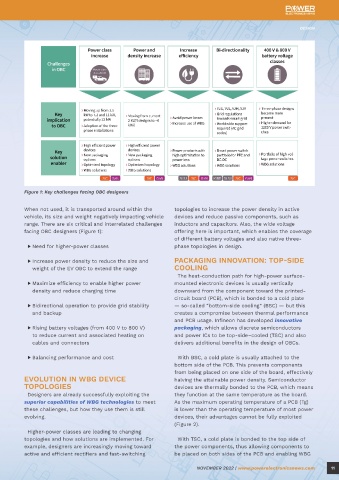
 Roadmap Toward   Figure 1: Key challenges facing OBC designers


 Higher-Power–Density   When not used, it is transported around within the   topologies to increase the power density in active
          vehicle, its size and weight negatively impacting vehicle
                                                              devices and reduce passive components, such as
                                                              inductors and capacitors. Also, the wide voltage
          range. There are six critical and interrelated challenges
 EV OBCs  facing OBC designers (Figure 1):                    offering here is important, which enables the coverage
                                                              of different battery voltages and also native three-
                                                              phase topologies in design.
             Need for higher-power classes
           ▶
 Key challenges, impactful innovations, and WBG solution   ▶  Increase power density to reduce the size and   PACKAGING INNOVATION: TOP-SIDE
                                                              COOLING
            weight of the EV OBC to extend the range
                                                               The heat-conduction path for high-power surface-
 enablers for major OBC trends  ▶  Maximize efficiency to enable higher power   mounted electronic devices is usually vertically
            density and reduce charging time                  downward from the component toward the printed-
 By Daniel Makus, global application manager for xEV and EV charging at Infineon   circuit board (PCB), which is bonded to a cold plate
 Technologies; Christian Mentin, senior scientist at Silicon Austria Labs; and Rafael   ▶  Bidirectional operation to provide grid stability   — so-called “bottom-side cooling” (BSC) — but this
 A. Garcia Mora, system application engineer for OBC applications at Infineon   and backup  creates a compromise between thermal performance
 Technologies   ▶  Rising battery voltages (from 400 V to 800 V)   and PCB usage. Infineon has developed innovative
                                                              packaging, which allows discrete semiconductors
            to reduce current and associated heating on       and power ICs to be top-side–cooled (TSC) and also
 The highly dynamic nature of the automotive industry   novel circuit topologies and innovations in packaging   cables and connectors  delivers additional benefits in the design of OBCs.
 means that designers of on-board chargers (OBCs)   on-board assemblies.
 for electric vehicles are faced with a set of goalposts   ▶  Balancing performance and cost  With BSC, a cold plate is usually attached to the
 that are constantly moving, as regulations relating   In this article, Infineon takes stock of the immediate   bottom side of the PCB. This prevents components
 to efficiency and grid integration are continuously   challenges facing OBC designers and discusses changes   from being placed on one side of the board, effectively
 reviewed and updated.  in how they are using WBG devices. It also considers   EVOLUTION IN WBG DEVICE   halving the attainable power density. Semiconductor
 how thermally managed device packaging and assembly   TOPOLOGIES  devices are thermally bonded to the PCB, which means
 To stay ahead of the game, designers are now   techniques can help significantly improve OBC power   Designers are already successfully exploiting the   they function at the same temperature as the board.
 pursuing ambitious targets, such as increasing the   density before presenting two reference designs that   superior capabilities of WBG technologies to meet   As the maximum operating temperature of a PCB (Tg)
 importance of high-power–density levels of OBCs. If   push the boundaries of currently attainable levels of   these challenges, but how they use them is still   is lower than the operating temperature of most power
 the state-of-the-art density was less than 2 kW/L   power density and can provide pointers for how even   evolving.  devices, their advantages cannot be fully exploited
 yesterday, current designs are going toward 4 kW/L   higher levels will be realized in the future.  (Figure 2).
 and suppose to increase to more than 6 kW/L by the   Higher-power classes are leading to changing
 end of the decade. Charting a course toward achieving   OBCs: DESIGN CHALLENGES  topologies and how solutions are implemented. For   With TSC, a cold plate is bonded to the top side of
 this figure over the longer term will be multi-faceted,   The role of the OBC in an EV is to convert AC grid   example, designers are increasingly moving toward   the power components, thus allowing components to
 requiring wide-bandgap (WBG) semiconductors in   power into a DC voltage to charge the traction battery.   active and efficient rectifiers and fast-switching   be placed on both sides of the PCB and enabling WBG

 10  NOVEMBER 2022 | www.powerelectronicsnews.com                     NOVEMBER 2022 | www.powerelectronicsnews.com   11

