


Page 6 - PEN eBook NOVEMBER 2022
P. 6
COVER STORY – DESIGN COVER STORY – DESIGN
The Wireless Power Consortium (WPC) manages the ▶ Base model: This includes the WLC1515 and the
respective specification release for this technology. OPTIGA™ Trust Charge device.
Currently, at version 1.3.2, the new release of Qi
specification clearly demonstrates the intent ▶ Mid-range model: This includes the base
for safe, high-power (>5 W) wireless charging by model with a PSoC™ microcontroller (MCU) to
adopting features such as enhanced foreign object support the controller area network (CAN) bus
detection (FOD), transmitter authentication with interface of the vehicle with additional GPIOs.
private key storage, and protocol features for better
interoperability. The Baseline Power Profile (BPP) of the ▶ High-end model: This includes the base model
Qi specification limits the maximum delivered power to with a TRAVEO™ T2G MCU to support the CAN
5 W, while the Extended Power Profile (EPP) supports a bus, NFC, and AutoSAR.
power transfer of up to 15 W.
The base model offers a Qi-certified solution with
Powerful smartphones are enabled with fast wired a local interconnect network (LIN) interface to
charging over a USB-C interface. The user experience communicate with the vehicle’s board control module.
of charging speed using Qi wireless power transfer is
still evolving, paving the way for new solutions. This The mid-range model offers a Qi-certified solution
article introduces Infineon’s first-generation wireless with a supplement MCU (PSoC™) to support the CAN
charging solution for automotive applications that interface and GPIOs to support the fan and additional
integrates the latest Qi transmitter, DC/DC controller, interfaces.
gate drivers, sensing/protection peripherals, and
configurable flash memory. Our programmable The high-end model offers a Qi-certified solution with
solution offers higher levels of flexibility along with the a supplement MCU (TRAVEO™ T2G) to support AutoSAR
integration benefits, enabling designers to scale higher compliance, CAN interface, NFC stack, and GPIOs to
power levels and allow OEMs to offer differentiated
Automotive In-Cabin features while remaining Qi-compatible. Secure communication and authentication
support the fan and additional interfaces.
The Qi EPP standard requires bidirectional in-band
Wireless Charging AUTOMOTIVE WIRELESS CHARGING communication. The communication from PTx to PRx
SOLUTION: IMPLEMENTATIONS
is based on a frequency shift keying (FSK) scheme
Solution with Highly WLC1515: integrated buck-boost and inverter implemented by the PTx, alternating the carrier-wave
power stage
frequency. The communication from PRx to PTx is
Infineon’s WLC1515 transmitter controller IC is a
based on an amplitude shift keying (ASK) scheme
*
Integrated Controller highly integrated Qi-compliant wireless transmitter created by modulating the load on the PRx side,
with an integrated DC/DC controller, gate drivers
causing a reflection to appear on the PTx, which is
for MOSFETs, and hardware-controlled protection
filtered and decoded.
features.
The Qi 1.3.x specification mandates authentication
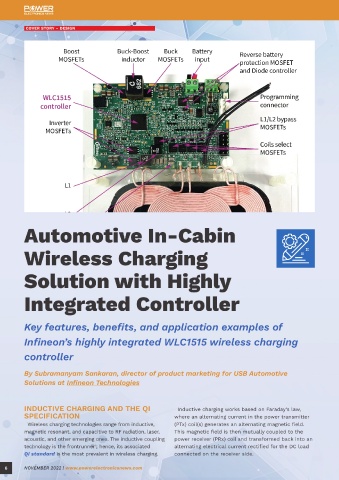
Key features, benefits, and application examples of The WLC1515 uses the integrated buck-boost controller for EPP power delivery greater than 5 W. It follows the
Infineon’s highly integrated WLC1515 wireless charging to generate the required bridge voltage to power the full- public key cryptography that relies on a public and
private key pair to encrypt and decrypt the content.
bridge inverter, which, in turn, supplies the PTx LC tank
controller to deliver power to the PRx. The buck-boost converter The private key is the most sensitive secure credential
supports an input voltage range of 4.5 V to 24 V.
and must be stored securely. The public key is typically
a part of the binary certificate, and this certificate
By Subramanyam Sankaran, director of product marketing for USB Automotive The integrated gate drivers of the WLC1515 are is transmitted to the recipient through the in-band
Solutions at Infineon Technologies designed to control a full-bridge or half-bridge inverter, communication medium.
depending on the Qi specification type and the
operating scenario. The MP-A13 coil-based transmitter According to the Qi specification, the PTx must
system shown in Figure 1 uses fixed-frequency securely host the product unit’s private key in a
INDUCTIVE CHARGING AND THE QI Inductive charging works based on Faraday’s law, variable-input voltage control for the inverter stage. storage subsystem for digital signature purposes.
SPECIFICATION where an alternating current in the power transmitter This private key is used to digitally sign the Challenge
Wireless charging technologies range from inductive, (PTx) coil(s) generates an alternating magnetic field. WLC1515 application use cases Authentication response from the power transmitter
magnetic resonant, and capacitive to RF radiation, laser, This magnetic field is then mutually coupled to the The Qi-certified automotive wireless charging solution device. Our solution uses the OPTIGA™ Trust Charge
acoustic, and other emerging ones. The inductive coupling power receiver (PRx) coil and transformed back into an can be segmented into three spaces: device for this private key storage (Figure 1). 5
technology is the frontrunner ; hence, its associated alternating electrical current rectified for the DC load
1
Qi standard is the most prevalent in wireless charging. connected on the receiver side. * Coming soon. For product availability or sample requests contact our support
6 NOVEMBER 2022 | www.powerelectronicsnews.com NOVEMBER 2022 | www.powerelectronicsnews.com 7

