


Page 23 - PEN_Ebook_October2021
P. 23
MOTOR CONTROL                                                                                Motor Control


            TWO-LEVEL INVERTER TOPOLOGY AND MOTOR CONTROL

            BASICS
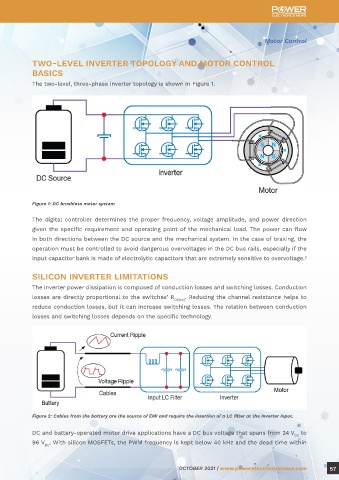
            The two-level, three-phase inverter topology is shown in Figure 1.


            Figure 1: DC brushless motor system

            The  digital  controller  determines the  proper frequency, voltage  amplitude,  and  power  direction
            given the specific requirement and operating point of the mechanical load. The power can flow
            in both directions between the DC source and the mechanical system. In the case of braking, the

            operation must be controlled to avoid dangerous overvoltages in the DC bus rails, especially if the
            input capacitor bank is made of electrolytic capacitors that are extremely sensitive to overvoltage. 3
 GaN Devices for Motor   SILICON INVERTER LIMITATIONS


            The inverter power dissipation is composed of conduction losses and switching losses. Conduction
 Drive Applications  losses are directly proportional to the switches’ R DS(on) . Reducing the channel resistance helps to

            reduce conduction losses, but it can increase switching losses. The relation between conduction
            losses and switching losses depends on the specific technology.
 By Marco Palma, director of motor drive systems and applications at Efficient
 Power Conversion


 Today, the permanent magnet motor, also known as the DC brushless motor, is widely used and
 offers  higher torque  capability  per  cubic  inch  and  higher  dynamics when  compared with  other
 motors. So far, silicon-based power devices have been dominant in inverter electronics, but today,
 their performance is nearing their theoretical limits.  There is an increasing need for higher power
 1,2
 density. Gallium nitride transistors and ICs have the best attributes to satisfy these needs.


 GaN’s superior switching behavior helps  to remove dead  time and increase PWM  frequency  to   Figure 2: Cables from the battery are the source of EMI and require the insertion of a LC filter at the inverter input.
 obtain unmatched sinusoidal voltage and current waveforms for smoother, silent operation with
 higher system efficiency. Power density increases with the substitution of electrolytic capacitors in   DC and battery-operated motor drive applications have a DC bus voltage that spans from 24 V  to
                                                                                                        DC
 the input filter with smaller, cheaper, and more reliable ceramic capacitors.  96 V . With silicon MOSFETs, the PWM frequency is kept below 40 kHz and the dead time within
                 DC


 56  OCTOBER 2021 | www.powerelectronicsnews.com                OCTOBER 2021 | www.powerelectronicsnews.com          57

