


Page 15 - PEN_Ebook_October2021
P. 15
Energy                                                                                              AUDIO


 not the first time something like this has happened. Taking a look at lighting, the transition from
 incandescent bulbs into compact fluorescents and then eventually to LED bulbs was the result of
 a progression in semiconductor technology over the time period. That innovation revolutionized the

 market and significantly reduced energy use associated with lighting in the house. It is these same
 types of trends that are now transitioning into major home appliances. As more energy regulations
 happen across industries, there will be an increase in the amount of semiconductor content in
 products. It will be the progression of semiconductor technology that will again lead the way.


 The semiconductor industry has been following potential regulations in the Americas since the
 beginning. As they become law, the semiconductor industry works with OEMs to understand what
 the regulations mean and the solutions available to them to bring their next generation of product
 to market.


 This can be daunting  to a manufacturer  that doesn’t have expertise in some of  these new   Class D Power
 technologies. That’s why it’s critical for OEMs to have a true partnership with a semiconductor
 company and utilize their expertise. The semiconductor partners tend to create reference design
 solutions  targeted  at  specific  applications.  These  reference  designs  can  offer  an  OEM  an  80%   Amplifier
 complete hardware and software solution, which is supported by schematic and board layout files.
 The OEM can then take that and productize it into a solution that fits the form factor of their end   By Nazar Sliunchenko, technical documentation manager at Dialog

 applicant and, by doing so, take ownership of it in terms of the application requirements for their   Semiconductor
 product space. Having the right semiconductor partner can ultimately reduce their time to market.
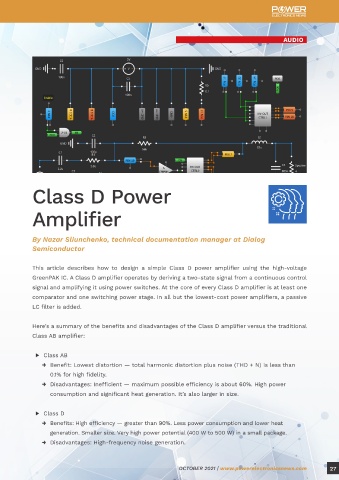
            This  article  describes  how  to  design  a  simple  Class  D  power  amplifier  using  the  high-voltage
 According to IEA, appliances account for 15% of global final electricity demand, or one-quarter of   GreenPAK IC. A Class D amplifier operates by deriving a two-state signal from a continuous control
 electricity used in buildings. As attention increasingly focuses on climate change, energy efficiency   signal and amplifying it using power switches. At the core of every Class D amplifier is at least one
 in appliances will be a key way to curb energy consumption and thus lower greenhouse gases.   comparator and one switching power stage. In all but the lowest-cost power amplifiers, a passive
 Appliance OEMs can expect more regulations and energy standards in the near future. Partnering   LC filter is added.
 with the right power semiconductor company will be critical to keeping pace.
            Here’s a summary of the benefits and disadvantages of the Class D amplifier versus the traditional

            Class AB amplifier:


             ▶   Class AB
                →    Benefit: Lowest distortion — total harmonic distortion plus noise (THD + N) is less than
 For More Information  0.1% for high fidelity.
                →    Disadvantages: Inefficient — maximum possible efficiency is about 60%. High power
                   consumption and significant heat generation. It’s also larger in size.
   ▶ Semiconductors: Powering the Future of Everything Efficiently from Energy
 Generation to Consumption  ▶   Class D

                →   Benefits: High efficiency — greater than 90%. Less power consumption and lower heat
   ▶ Understanding the Semiconductor Shortage  generation. Smaller size. Very high power potential (400 W to 500 W) in a small package.

                →   Disadvantages: High-frequency noise generation.


 26  OCTOBER 2021 | www.powerelectronicsnews.com                OCTOBER 2021 | www.powerelectronicsnews.com          27

